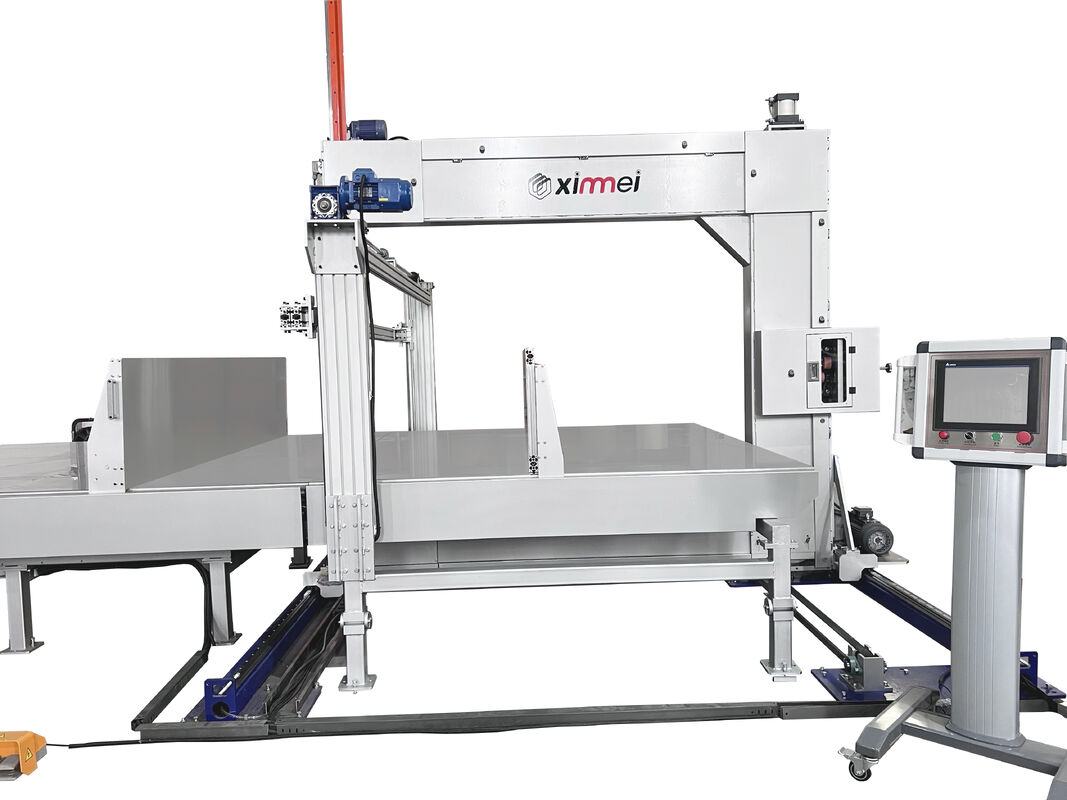
TDP-4LS Automatic Vertical Foam Cutting Machine for 2000x2000x1250 mm PU Foam Blocks
Product Introduction
The TDP-4LS is an automatic vertical foam cutting machine built for factories that need to turn large PU foam blocks into precise slices, strips and rectangular blanks. It uses a moving cutting frame that travels along linear guide rails, while two fixed platform baffles clamp the foam block from both sides. The baffle moves left and right to set the cutting width, so the same machine handles both thin vertical slices and wider block splitting.
Unlike a manual vertical cutter, the TDP-4LS does not depend on the operator holding or guiding the block. Once the cutting width and speed are entered on the control panel, the servo speed regulation and PLC control system manage the reciprocating movement of the cutter frame automatically, and the machine stops through the panel at the end of the cycle. That is what makes unattended running possible and removes the need for continuous manual guarding.
The working envelope is built around standard block sizes in the furniture and packaging industry: an internal table of 2300×2400 mm, an external table of 2400×2400 mm, and a maximum cutting size of 2000×2000×1250 mm. Foam thickness can be set anywhere from 2 mm to 1250 mm, which means one machine can prepare thin facing sheets and full-height block sections on the same shift.
With a gross power of 6.08 kW and a machine weight of 2500 kg, the TDP-4LS is economical to run while still heavy enough to stay stable during cutting. It is aimed at foam converters, mattress and sofa factories, packaging plants and deep-processing workshops that want to move from manual vertical cutting to a repeatable, automated process.
Machine Structure and Working Principle
The machine is organised around three functional groups: the fixed worktable with side baffles, the moving cutting frame on linear guides, and the servo plus PLC control system. Each group solves a different part of the cutting problem.
- Fixed platform and side baffles: the foam block is placed on the table and clamped between two baffles, so it cannot shift while the blade passes. The baffle on the cutting side moves left and right, which is how the cutting width is set without repositioning the block.
- Linear guide reciprocating frame: the cutting frame travels back and forth on linear guide rails rather than swinging on an arm. Linear guidance keeps the blade path straight and gives a smooth, even cutting edge on long blocks.
- Servo speed regulation: feed and frame movement are driven by servo motors, so speed changes are smooth and repeatable instead of being stepped through a gearbox.
- PLC automatic control: the PLC stores cutting width and speed, controls the forward and backward movement of the band knife frame, and stops the cycle through the control panel.
- Band knife cutting head: the vertical band knife performs the actual cut, producing a straight vertical face on blocks and strips.
- Control panel: operators set parameters on the panel; no mechanical handwheel adjustment is needed between different cutting widths.
How a Cutting Cycle Works
- Load the block: the PU foam block is placed on the internal table and pushed against the fixed baffle.
- Clamp: the movable side baffle closes on the block and holds it firmly for the whole cut.
- Set the width: the required cutting width is entered on the control panel; the baffle position and frame travel are set accordingly.
- Set the speed: cutting speed is selected for the foam density and block size, fast for soft foam and slower for dense or tall blocks.
- Automatic cutting: the cutting frame reciprocates along the linear guides and the band knife separates the slice or strip from the block.
- Unload and repeat: the finished piece is removed, the baffle repositions for the next width, and the cycle restarts from the panel.
Key Selling Points
- Servo and PLC automatic control: cutting width and speed are set on the panel, and the machine runs the cycle without continuous operator input.
- Linear guide reciprocating cutting: the frame travels on linear rails for a straight blade path and a smooth cutting edge on blocks and strips.
- Adjustable side baffles: the movable baffle clamps the block firmly and adapts to different cutting widths without re-setting the foam.
- Large working envelope: 2300×2400 mm internal table and 2000×2000×1250 mm maximum cutting size cover standard furniture and packaging blocks.
- Wide thickness range: 2–1250 mm lets one machine produce thin sheets, thick sections and block strips.
- Safe and labour-saving: no manual guarding is required during the cut, which reduces labour cost and keeps hands away from the blade.
- Compact power demand: 6.08 kW gross power and 2500 kg machine weight keep installation and running costs low for a machine of this table size.
Technical Specifications
| Item | Parameter |
|---|
| Model | TDP-4LS |
| Internal table size (L×W) | 2300×2400 mm |
| External table size (L×W) | 2400×2400 mm |
| Cutting sponge size (L×W×H) | 2000×2000×1250 mm |
| Cutting sponge thickness | 2–1250 mm |
| Gross power | 6.08 kW |
| Machine weight | 2500 kg |
| Overall dimension (L×W×H) | 5000×2600×2500 mm |
| Control system | Servo speed regulation with PLC automatic control |
| Cutting frame | Reciprocating frame on linear guide rails |
| Clamping | Fixed platform baffles with left-right movable side baffle |
| Certification | CE |
Cutting Performance and Thickness Control
Cutting width on the TDP-4LS is controlled by the position of the movable baffle rather than by the operator's eye. That is the main difference from manual vertical cutting: the same setting produces the same width on the next block, and the next shift, without re-measuring every piece. For thin slices, the baffle is brought close to the blade and the frame travel is shortened accordingly; for block splitting, the baffle moves out and the frame runs a longer stroke.
Thickness settings from 2 mm to 1250 mm are entered on the panel. Very thin slices require a slower feed and a sharp band knife, especially on soft low-density foam where the material tends to compress. Tall blocks near the 1250 mm limit benefit from a moderate speed so the blade does not deflect in the middle of the cut. Because the block is clamped on both sides, the cut face stays vertical even at full height, which reduces the trimming work needed before lamination or profiling.
The linear guide frame also matters for surface quality. A frame that swings or runs on worn ways leaves chatter marks that show through fabric or film after lamination. Reciprocating movement on linear rails keeps the blade on a straight path, so the cut face is smooth enough for direct use in sofa cushions, mattress cores and packaging inserts.
Primary Applications
- Furniture industry: vertical cutting of PU foam blocks for sofa cushions, armrests and backrest cores.
- Mattress production: preparing foam block sections and strips for mattress cores, quilting layers and edge support.
- Packaging sector: cutting foam blocks into strips and rectangular pieces for shock-absorbing packaging.
- Sponge deep processing: pre-cutting foam blanks before horizontal slicing, profiling or die-cutting.
- Shoe and textile materials: vertical cutting of sponge blocks for padding, lining and reinforcement raw material.
- Automotive interiors: cutting seat padding blocks and acoustic foam sections to size.
Safety and Operation
Safety is built into the working method rather than added as an accessory. The block is clamped between baffles and the cutting frame moves on rails, so the operator does not hold or guide the foam during the cut. Parameters are set on the control panel before the cycle starts, and the machine stops through the panel at the end of the stroke. This layout removes the most common cause of injury on vertical cutters — hands close to the blade while pushing foam through.
Operators should still follow three basic rules: never reach into the cutting zone while the frame is moving, keep the table and guide rails free of foam off-cuts that could block the baffle, and check the band knife tension at the start of each shift. A short training session is enough for a new operator to set width and speed and run a complete cycle.
Installation, Training and Maintenance
The machine is delivered with a layout drawing, wiring diagram and English operation manual. It needs a level concrete floor with enough clearance for the 5000×2600×2500 mm footprint plus access for loading blocks and removing cut pieces. Commissioning support is provided remotely, and on-site installation with operator training can be arranged on request.
Routine maintenance focuses on four points: band knife tension and tracking at the start of each shift, cleaning foam dust from the linear guides and baffle tracks daily, lubricating the guide rails and baffle movement weekly, and checking the blade for dullness or damage monthly. Worn band knives can be replaced on site, and spare blades and guide components can be shipped with the machine to avoid production stops waiting for imports.
Quality Control, Packaging and Shipping
Every TDP-4LS is assembled, aligned and run before shipment. The cutting frame travel, baffle movement and panel settings are checked, and a sample foam block is cut to confirm the finished width and cut face. Electrical configuration is CE compliant for European and other export markets.
The main frame is shipped with rust-proof treatment and protective film, while the control cabinet, servo components and small spare parts are packed in wooden cases. The machine is loaded and secured for container transport, and standard delivery is 45 working days after the down payment is confirmed, shipped from Qingdao port. Payment terms are T/T or L/C, minimum order quantity is one set, and supply ability is three sets per season.
Frequently Asked Questions
Q: Does this machine cut curved or contoured foam shapes?
A: No. It makes straight vertical cuts, so the output is square or rectangular blocks and strips. For curved profiles, a CNC contour cutting machine is the correct choice.
Q: How is the cutting width changed, and how long does it take?
A: The movable side baffle is positioned from the control panel, so the block does not need to be moved or re-measured. A width change takes seconds rather than the fixture re-setting required on a manual cutter.
Q: Can it cut slices as thin as 2 mm reliably?
A: The range starts at 2 mm, but thin slices need a slower feed and a sharp band knife. If your main product is continuous thin sheet, a horizontal skiving machine such as the TDPB-1900 is the better match.
Q: What happens if the block is taller than 1250 mm?
A: It cannot be cut in one pass. The maximum block size is 2000×2000×1250 mm, so taller blocks must be split on a horizontal machine first.
Q: Will the clamps damage soft foam?
A: The baffles clamp the block to stop movement during the cut; very soft foam may show slight compression at the contact faces, which is normally trimmed off. If edge quality is critical, reduce clamping force and check the first block.
Q: Can it be connected to a conveyor or an existing production line?
A: The table layout and discharge side can be matched to your line, and roller conveyor sections can be arranged. Share your layout and we will confirm the loading and unloading direction before production.
Q: Is it safe to run without an operator standing at the blade?
A: Yes. The block is clamped and the frame runs on rails, so nobody needs to hold or guide the foam. The operator sets the parameters and starts the cycle from the panel — the same reason no manual guarding is required.
Q: What causes most unplanned downtime on this machine?
A: Two things: band knife tension and tracking, and foam dust on the linear guides. A tension check at the start of each shift and daily cleaning of the guide rails prevent almost all of it.
Q: How many operators are needed?
A: One. Loading the block and removing finished pieces are the only manual steps; width setting, frame travel and stopping are automatic.
Q: What is required on site before installation?
A: A level concrete floor that can carry 2500 kg, a 6.08 kW supply matched to your voltage and frequency, and clearance around the 5000×2600×2500 mm footprint for block loading and piece removal.
Request a Quotation
Tell us your foam block size, target slice thickness, daily output and workshop layout. We will confirm the table configuration, band knife specification, spare parts list and delivery schedule, and can arrange a cutting test on your material at our Qingdao plant or by video.


 Your message must be between 20-3,000 characters!
 english
 français
 Deutsch
 Italiano
 Русский
 Español
 português
 Nederlandse
 ελληνικά
 日本語
 한국
 العربية
 हिन्दी
 Türkçe
 indonesia
 tiếng Việt
 ไทย
 বাংলা
 فارسی
 polski