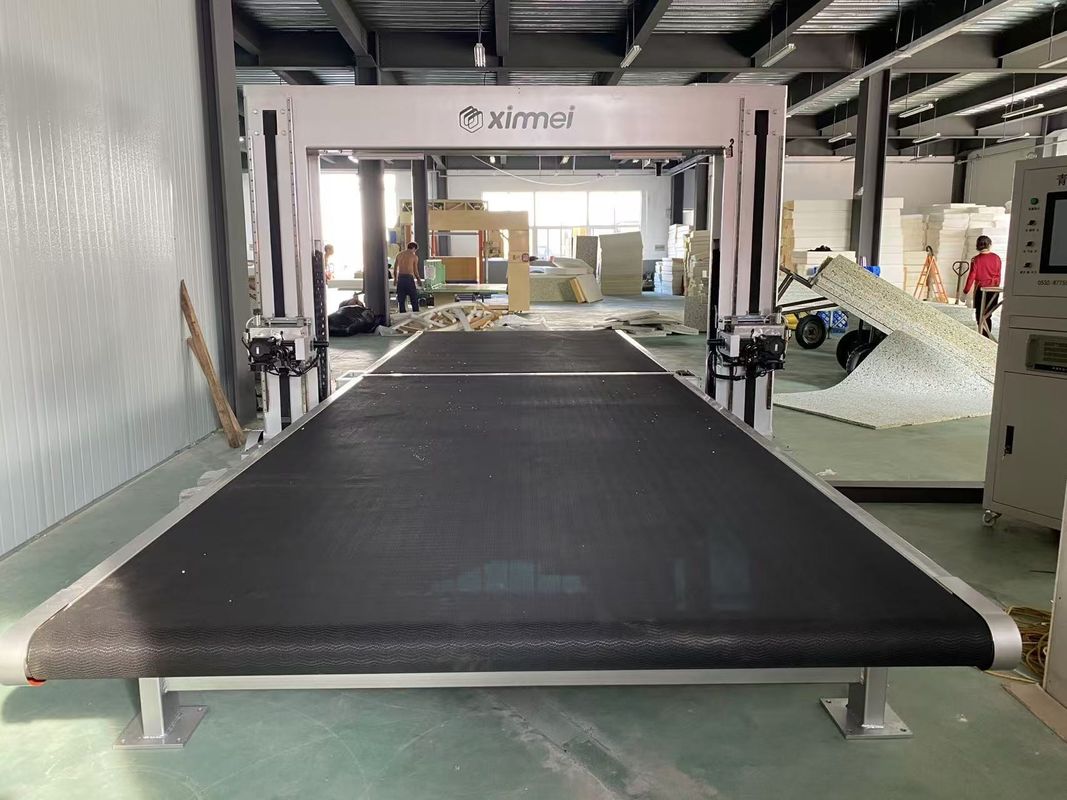
TDPF-01 Automatic Dual Oscillating Blade CNC Foam Cutting Machine
Product Introduction
The TDPF-01 is an automatic dual oscillating blade CNC foam cutting machine designed for factories that need to turn large foam blocks into finished three-dimensional shapes without investing in a separate punch die for every profile. Two independently driven vibrating blades follow the programmed path, so the machine can produce simple 3D contours, bevels, rounded corners and thin irregular sheets in one continuous cycle. The working envelope accepts blocks up to 3000×2300×1300 mm, which covers the standard block sizes produced by most continuous and batch foaming lines.
What separates this model from a conventional rotary-table contour cutter is its ability to process thin special-shaped foam sheets. A rotary table relies on the block being tall enough to stay stable while it turns; once the workpiece becomes a thin sheet, the table can no longer hold the profile accurately. The TDPF-01 avoids that limitation because the blade moves around a stationary, vacuum-assisted table, so the same machine can cut a 1300 mm block in the morning and a 6 mm packaging insert in the afternoon.
The machine is equally useful as a replacement for punch die cutting. For non-perforated single foam parts, a die set has to be machined, stored, mounted and eventually replaced, and each design change means a new die. On the TDPF-01 the profile is simply a program: change the drawing, run a sample, and the new part is in production. For short runs, custom packaging inserts and furniture parts with frequent design changes, this removes both the tooling cost and the waiting time for a new die.
Typical buyers are foam converters, packaging plants, mattress and furniture factories, and display or exhibition prop makers. The machine is built around a servo-driven dual blade head, a 10 kW power package and a 3000 kg welded frame that keeps vibration low during high-speed oscillation. Cutting tolerance is held at ±0.5 mm, and the minimum cutting size is 5 mm, giving users a practical range from thin sheets to full production blocks.
How Dual Oscillating Blade Cutting Works
Oscillating blade cutting does not remove material like a milling cutter or a hot wire. The blade moves up and down at high frequency with a very small stroke, and the sharp edge separates the foam cells as the profile is fed forward. Because there is no kerf and no melting, the cut edge stays clean, the foam does not densify, and there is no burnt odour or hardened wire mark that later causes delamination in lamination or gluing operations.
On the TDPF-01 the two blades are carried on a servo-controlled head. The servo system runs at 2400–2800 r/min and positions the blade along the programmed path while the maximum processing speed reaches 6.3 m/min. One blade is normally fitted with the 2400×3×0.5 mm tool for deep block work, and the 1600×3×0.5 mm tool is used for tighter radii and thinner sections. Operators can change tools according to the profile rather than forcing one blade to do every job.
A cutting cycle is straightforward. The operator loads the block onto the table, switches on the vacuum hold-down, selects or downloads the program, sets the blade speed and feed rate for the foam grade, and starts the cycle. The machine completes the contour, returns to the loading position, and releases the vacuum. For repeated work the program is stored and recalled by part number, so output between shifts remains identical.
Machine Structure and Key Components
The frame is a heavy welded steel structure with a machined table surface. At 3000 kg and an overall size of 6480×3200×2300 mm, the base is intentionally massive: the mass absorbs the reaction force of the oscillating blades and keeps the cutting head stable when it changes direction at speed.
- Dual oscillating blade head — two servo-driven blade holders with independent tension and guide systems, allowing 2400 mm and 1600 mm blades to be used according to the profile.
- Servo motion system — closed-loop control at 2400–2800 r/min with acceleration and deceleration profiles tuned for foam, so the head does not tear the material at corners.
- Vacuum hold-down table — a perforated table surface connected to a vacuum source holds thin sheets and flexible blocks flat without mechanical clamps that would mark the foam.
- Control cabinet and touch screen — stores part programs, blade speed, feed rate and vacuum settings; production counters help supervisors track output by shift.
- Blade guides and tensioners — reduce lateral movement of the thin blade, which is the main factor behind dimensional drift on long runs.
- Safety enclosure and interlocks — the cutting zone is guarded and the cycle stops when the guard is opened.
Key Selling Points
- Simple 3D profiling without a die — handles contoured parts, bevels and rounded edges that would otherwise require a punch die, reducing tooling investment and changeover time.
- Thin sheet capability — processes irregular sheets down to a 5 mm minimum cutting size, a job that rotary-table 3D cutters handle poorly.
- Repeatable ±0.5 mm tolerance — servo positioning and rigid blade guidance keep dimensions stable across a long batch, so downstream assembly does not need rework.
- Dual blade flexibility — long blade for deep cuts, short blade for tight radii; one machine covers both block profiling and detailed insert work.
- Clean, sealed cut edge — no melting or densification, which protects glue joints in lamination and keeps the foam compressible right to the edge.
- Low operating cost — no die maintenance, no hot-wire consumption, and blades are re-sharpened or replaced at low cost.
Technical Specifications
| Maximum block size |
3000×2300×1300 mm |
| Cutting tools |
2400×3×0.5 mm and 1600×3×0.5 mm oscillating blades |
| Servo system speed |
2400–2800 r/min |
| Maximum processing speed |
0–6.3 m/min |
| Cutting tolerance |
±0.5 mm |
| Minimum cutting size |
5 mm |
| Total power |
10 kW |
| Machine weight |
3000 kg |
| Machine dimension (L×W×H) |
6480×3200×2300 mm |
Cutting Accuracy and Edge Quality
Tolerance is only useful if it survives a full production run. Three factors decide that on a foam contour machine: blade guidance, feed consistency and how the workpiece is held. The TDPF-01 addresses all three. The blade is constrained by close-tolerance guides directly above and below the cut, so lateral deflection is limited even when the head changes direction quickly. The servo feed maintains a constant advance rate through curves instead of slowing and speeding up with the operator's hand. The vacuum table keeps the block from shifting, which is especially important on the final pass when the remaining wall becomes thin.
For most PU and PE foams, users can expect a square, clean edge with no visible tear-out. Softer grades such as very low-density EPE benefit from a slightly higher oscillation speed and a lower feed rate; harder grades such as high-density PU and EVA can be run faster. Because the blade separates rather than tears, the cell structure at the cut face stays open, which improves adhesion in the next process and avoids the hard, glazed surface left by hot-wire cutting.
Material Compatibility
- PU flexible foam — furniture cushions, mattress layers, packaging inserts and convoluted profiles.
- PE and EPE pearl wool — protective packaging, fragile-goods inserts and laminated sheets.
- EVA — shoe soles, sports mats, tool inlays and costume parts.
- Rigid and semi-rigid PU — insulation boards, model-making and decorative panels.
- Melamine and acoustic foam — panels requiring a clean edge without crumbling.
- Recycled foam bonded block — where consistent density allows a clean oscillating cut.
The machine is not intended for foam containing hard inclusions, abrasive fillers or metal inserts. For those materials a different cutting method should be selected, and our technical team will say so before an order is placed.
Primary Applications
Packaging Industry
Custom contoured inserts, corner buffers, trays and shock-absorbing cradles for electronics, instruments, glassware and medical devices. The ability to cut thin sheets means a packaging plant can run both the outer block and the thin internal divider on one machine.
Furniture and Mattress Production
Shaped cushion cores, sofa arm profiles, mattress transition layers and decorative foam components. Cutting directly from a program shortens the sampling cycle when a customer approves a new shape.
Display and Decoration
Exhibition props, 3D logos, stage scenery, architectural models and window-display shapes. These jobs are typically one-offs, which makes die-based production uneconomical and CNC contour cutting the natural choice.
Foam Converting Factories
Replacing punch die cutting for non-perforated single foam parts. A converter that currently stores dozens of dies can move low-volume profiles to the TDPF-01 and keep dies only for high-volume, perforated or very thick parts.
Position in the Foam Production Line
The TDPF-01 sits in the shaping stage of the foam line. Upstream, it receives blocks from a foaming line, a horizontal peeling machine or a vertical block cutter. Downstream, its output feeds lamination, gluing, quilting, upholstery or packaging assembly. The link to the previous process is important: the block should have a reasonably flat bottom and square sides, because the vacuum table needs a sealing surface and the program assumes a known reference edge.
In a typical layout, a vertical cutter squares the block to size, the TDPF-01 produces the profile, and a lamination line bonds the shaped part to fabric or another foam layer. Where the plant also runs a horizontal peeling machine, thin sheets can be peeled first and then profiled on the TDPF-01, which is often more economical than cutting thin sections directly from a full block. We can review the complete process with the buyer and recommend the machine sequence, table size and material flow before shipment.
Comparison with Alternative Cutting Methods
- Versus punch die cutting: no die cost, no die storage, and design changes take minutes instead of days. Die cutting remains faster for very high volumes of a single small part.
- Versus rotary-table 3D cutting: the TDPF-01 handles thin sheets and irregular profiles that lose stability on a rotating table, and it does not need the block to be clamped and turned.
- Versus hot-wire cutting: no melted or hardened edge, no wire consumption, no fumes, and better glue adhesion on the cut face.
- Versus manual cutting: repeatable dimensions, lower dependence on operator skill, and a documented program for every part.
Safety, Operation and Training
The cutting zone is enclosed by guards with interlocks, and the control system prevents the cycle from starting if the guard is open. Emergency stops are placed at the operator position and at the rear of the machine. Blade changes are carried out with the drive isolated and with cut-resistant gloves; a spare blade set should be kept on site so a damaged edge does not stop production.
Operation is learned quickly. A new operator typically needs one to two days to load programs, set the vacuum, select blade speed and run a first article. Programming is done offline from a DXF or drawing and transferred to the machine; the operator does not need to write code at the machine. We provide a training session at installation, a printed operation manual and remote support for program preparation.
Installation, Maintenance and Spare Parts
- Foundation: a level, reinforced concrete floor capable of carrying the 3000 kg machine plus the workpiece; anchor points are supplied.
- Power: a dedicated supply matching the 10 kW total connected load, with correct earthing and a stable voltage.
- Air and vacuum: clean, dry compressed air for the hold-down and pneumatic functions; the vacuum table requires a suitable blower or vacuum pump sized for the table area.
- Daily checks: blade tension, blade condition, guide cleanliness and vacuum performance.
- Weekly checks: guide wear, belt tension, lubrication points and electrical connections.
- Spares: oscillating blades, blade guides, tension springs, vacuum filter elements and proximity sensors are the usual consumables; we keep these available for repeat buyers.
Blade life depends on foam density and abrasive content, but a well-run machine normally gives weeks of production per blade. When the cut edge starts to show fuzz or the machine needs a higher feed force, the blade is re-sharpened or replaced. Guide wear is the second maintenance item to watch, because worn guides allow lateral movement and gradually open the tolerance.
Quality Control, Packaging and Shipping
Each machine is assembled, wired and run before shipment. The test report covers blade oscillation, servo response, vacuum hold-down, guarding, emergency stop and a sample contour cut measured against the drawing. The buyer receives the inspection record with the machine.
The machine is shipped in an export-grade package with the table and frame protected against moisture, the blade head secured, and loose parts boxed and labelled. Packaging details are confirmed with the buyer before dispatch because the 6480×3200×2300 mm frame may require a flat-rack or an open-top container depending on the route. Delivery is 45 working days after downpayment, and payment terms are T/T or L/C.
Selecting the Right Machine
The TDPF-01 is the right choice when the work mixes blocks and thin profiles, when 3D shapes are needed without a die, or when a rotary-table machine cannot hold thin sheets. It is not the best choice for very high-volume single-part production where a die has already been amortised, or for foam containing hard inclusions. Buyers should confirm the maximum block size, the smallest part they intend to cut, the foam grades, the available power and floor space, and whether the output feeds a lamination or packaging line. Sharing those details lets us confirm the machine configuration and the tooling set before the order.
Frequently Asked Questions
Q: Can it really cut thin sheets, or only large blocks?
A: Both. The minimum cutting size is 5 mm, and the vacuum table holds thin sheets flat while the blade follows the contour. This is the main difference from rotary-table 3D cutters, which lose accuracy once the workpiece becomes thin.
Q: What happens if my block is larger than 3000×2300×1300 mm?
A: It cannot be loaded as one piece. The block should be squared down on a vertical or horizontal cutter first, or split into sections. If most of your production exceeds this envelope, tell us the actual size and we will advise on a larger configuration instead of forcing this model.
Q: The bottom of my block is uneven. Will the cut still be accurate?
A: A flat bottom is important because the vacuum table needs a sealing surface and the program references the table plane. A badly bowed block should be squared first; a slightly rough surface is normally acceptable, but the first cut may need a small allowance.
Q: Do operators need programming skills?
A: No machine-side programming is required. Files are prepared offline from a drawing or DXF and downloaded to the controller; the operator selects the program, sets blade speed and feed, and starts the cycle. Training at installation is included.
Q: How often do blades need changing, and what does it cost?
A: Blade life depends on foam density and filler content, but most users run for weeks between changes. Blades can be re-sharpened several times. Keeping one spare set on site is recommended so a damaged edge does not stop the line.
Q: Can the finished parts go straight into our lamination or packaging line?
A: Yes. The oscillating cut leaves an open, unsealed cell face that bonds well with adhesive, and the ±0.5 mm tolerance is normally tight enough for direct assembly. For automated lines, we can discuss output handling and part stacking with your process team.
Request a Quotation
Tell us the block size you start from, the smallest part you need to cut, the foam grades and densities, and the downstream process. We will confirm the TDPF-01 configuration, the blade set, the power requirement and the delivery schedule, and send a quotation with the recommended options. Sample cuts can be arranged from your material before the order is placed.


 Your message must be between 20-3,000 characters!
 english
 français
 Deutsch
 Italiano
 Русский
 Español
 português
 Nederlandse
 ελληνικά
 日本語
 한국
 العربية
 हिन्दी
 Türkçe
 indonesia
 tiếng Việt
 ไทย
 বাংলা
 فارسی
 polski