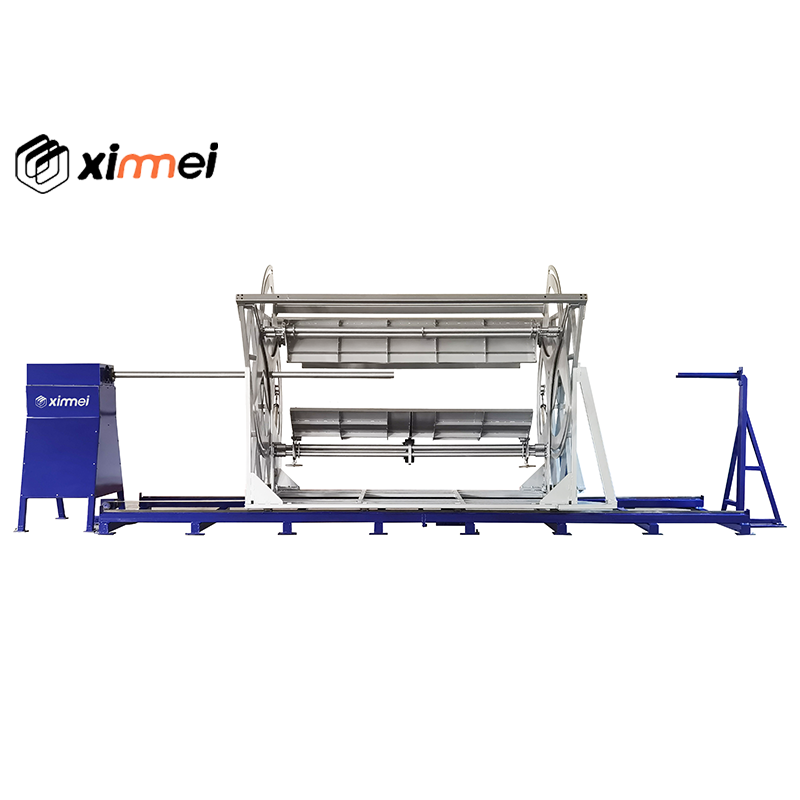
C518 3-direction Clamping Cylinder Foam Boring Machine Auto Threading
3-Direction Clamping Foam Boring Machine with Automatic Threading for 500-2300mm Boring Length
The C518 3-direction clamping foam drilling machine is a combined boring and shaft-threading unit built for cylindrical PU foam production lines. It drills a centered hole through a cylindrical sponge block and threads the hanging bar through that hole in the same automated cycle, so the block is ready for the peeling and skiving machine without any manual bar handling.
The machine is normally installed directly after the vertical cylinder foaming machine and directly before the foam peeling machine. In this position it removes the bottleneck that appears when bore holes are drilled on a horizontal drill and the bar is still pushed through by hand: the hole is centered with a three-direction clamping structure, the bar is inserted automatically, and the block leaves the station square and ready for continuous peeling.
Why the Boring and Threading Station Matters in a Cylinder Foam Line
Peeling machines turn a cylindrical foam block into a continuous sheet by rotating the block around its own axis while a blade peels material from the outer surface. For that rotation to be stable, the block must first carry a straight, centered bore hole with a steel bar through it. If the hole is off center, the block runs out of balance, the peeled sheet varies in thickness, and the blade has to be backed off to avoid tearing.
That is why the boring step controls the quality of everything downstream. A hole that is centered within a small tolerance keeps the peel thickness consistent, reduces scrap at the start and end of the block, and lets the operator run the peeling machine at a steady feed instead of constantly correcting. The C518 addresses this with two design choices: a three-direction clamping structure that holds the cylinder on three sides during drilling, and an automatic center positioning function that finds the geometric center of the cylinder before the drill enters the foam.
Because the same station also performs the bar threading, the block does not need to be released, moved and re-clamped between drilling and bar insertion. The bar is driven through the freshly drilled hole while the block is still held in the centered position, which removes the most common source of misalignment in manual operation.
Three-direction Clamping and Automatic Center Positioning
The clamping system holds the cylindrical block from three directions, so the foam cannot rotate, lift or spring away from the drill axis during penetration. Foam is a compressible material: a two-point clamp lets the block deform slightly under drilling thrust, and that deformation is enough to pull the bore off line on long holes. Three-direction clamping spreads the holding force around the circumference and keeps the cylinder round while the drill travels through it.
Stable Holding on Compressible Foam
Clamping force is distributed around the cylinder so the block keeps its round section and the bore stays straight through the full length.
Automatic Center Positioning
The machine locates the center of the cylinder automatically before drilling, so the operator does not have to mark or measure the block by hand.
Less Foam Waste
A centered hole means a thinner minimum peel allowance and less material removed to correct an eccentric bore, which raises overall material utilization.
Automatic center positioning is particularly useful when blocks come from different foaming cycles and vary slightly in diameter and shape. Instead of relying on the operator to judge the center visually, the machine re-references each block before the drill advances, which keeps the bore consistent from block to block and shift to shift.
Automatic Shaft Threading Instead of Manual Insertion
On a conventional setup, the bar is pushed through the bore by two operators with a guide, and the block is often re-clamped or rolled to align the hole with the bar. This is slow, it exposes operators to repetitive handling of a heavy bar, and it can damage the bore wall if the bar is not perfectly aligned with the hole.
The C518 completes the threading step automatically as part of the same cycle. Once the bore is finished and the block is still held in the centered position, the bar is fed through the hole along the same axis as the drill. The results are practical rather than theoretical:
Labor saving: the threading step no longer needs a second operator holding and guiding the bar.
Time saving: drilling and threading happen in one setup instead of two separate handling steps.
Better bore quality: the bar follows the drill axis, so the bore wall is not scraped or enlarged during insertion.
Safer operation: operators are not standing in line with a heavy bar being pushed through a foam block.
Technical Specifications
Hole diameter
50 – 80 mm
Bore hole length
500 – 2300 mm
Sponge diameter
1200 – 1500 mm
Motor power
3.7 kW
Machine weight
2000 kg
Overall dimension (L×W×H)
6500 × 2000 × 2500 mm
The figures above are the standard configuration of the C518. Hole diameter, bore length and sponge diameter define which blocks the machine can accept; the motor power, weight and footprint define the site requirements. For blocks outside these ranges, the working range should be checked against the actual block size before ordering.
Where the Machine Sits in the Production Line
1Vertical cylinder foaming
2Cylinder block curing
3C518 boring + threading
4Peeling / skiving
5Sheet winding
The natural upstream machine is a vertical cylinder foaming machine: it produces the round block that the C518 prepares. The natural downstream machine is a foam peeling or skiving machine, which needs the bar-threaded block to rotate the foam against the blade. When these three machines are laid out in sequence, the block flows from foaming to boring to peeling with a single handling step at each transfer, and the buffer between stations can be kept small.
For plants that also run block foam lines, the C518 is not a substitute for a horizontal boring machine. Block foam is drilled and peeled on different equipment; the C518 is specifically the preparatory station for cylindrical foam that will be peeled into continuous sheet. Keeping the two routes separate avoids re-clamping round blocks on a machine designed for rectangular bales.
Materials and Finished Products
The machine is used with cylindrical polyurethane foam, including the flexible PU grades that are peeled into thin sheets for mattresses, upholstery, packaging and lamination. It is a mechanical boring and threading station, so the foam grade mainly affects the drilling feel and the chip load rather than the machine configuration: softer, lower-density foam needs a sharper, cleaner cut to avoid tearing at the bore entry, while denser foam places more load on the drill and rewards the stable three-direction clamping.
Typical downstream products made from the peeled sheet include mattress comfort layers, upholstery padding, foam laminates, packaging inserts and technical foam rolls. Because the bore position decides how evenly the block rotates during peeling, the C518 has a direct effect on the thickness tolerance of those finished sheets, not just on the boring step itself.
Selection Guide: Matching the Machine to Your Block
Four numbers decide whether the standard C518 fits a given production line. Buyers should confirm all four against the blocks they actually run, not against a nominal size:
Sponge diameter (1200 – 1500 mm): the outside diameter of the cylindrical block. If the plant runs more than one block size, confirm the full range fits inside this window.
Hole diameter (50 – 80 mm): the bore size, which should match the bar diameter used on the peeling machine. The bar must pass through the bore without forcing.
Bore hole length (500 – 2300 mm): the length of block that can be drilled in one pass. Longer blocks need a different configuration.
Block weight and handling: the 2000 kg machine weight and 6500 × 2000 × 2500 mm footprint define both the floor loading and the space needed for loading and unloading.
It is also worth confirming the peeling machine's bar diameter and the height of its loading station at the same time, so the C518 discharge height and the peeling machine infeed can be aligned during layout rather than adjusted on site.
Site Preparation, Power and Compressed Air
The C518 needs a level, load-bearing floor that can carry the machine and the block during clamping. The footprint is 6500 × 2000 × 2500 mm, but the practical space requirement is larger, because the block has to be brought in, aligned and taken out with a crane, hoist or roller conveyor. Leave clear access at both ends of the machine and keep the operator station free of stacked material.
The installed motor power is 3.7 kW. The site should provide a dedicated supply sized for the machine plus a safe margin, with correct earthing and a local isolator within reach of the operator. Any pneumatic or hydraulic functions used for clamping and bar feeding should be connected to a clean, dry air supply; moisture and oil carry-over are the usual cause of erratic clamping on foam machinery. Final utility requirements should be confirmed against the machine's electrical and pneumatic diagrams before installation.
Installation, Commissioning and Operator Training
Installation starts with positioning the machine on its foundation, leveling it, and anchoring it so the clamping forces do not walk the frame over time. After mechanical alignment, the drill axis and the bar feed axis are checked against each other; this is the single most important commissioning step, because any offset between the two shows up later as a bore that is straight but not aligned with the bar.
Commissioning then moves to a trial block: center positioning is verified, a bore is drilled, the bar is threaded, and the block is checked for wall thickness around the bore. Operators are trained on three points that matter most in daily running: confirming the block is seated before clamping, checking that the bar path is clear before threading, and stopping the cycle immediately if the drill sound changes. Training also covers the daily checks and the lockout procedure for clearing jammed foam or a mis-fed bar.
Daily Operation and Maintenance
Foam dust and chips are the main enemy of a boring machine. The drill, the clamp guides and the bar feed should be cleaned at the end of each shift, and dust should not be allowed to build up on the center-positioning components. A clean machine positions more accurately and runs cooler.
Each shift: check clamp pads for foam buildup, confirm the bar path is clear, inspect the drill for damage or buildup.
Weekly: check the drill mounting and the bar feed alignment, clean and lubricate guideways, inspect belts and fasteners for looseness.
Periodically: replace the drill according to wear rather than waiting for a poor bore, check the clamping pressure, and verify that center positioning still repeats on a known block.
Spare parts that are worth holding in stock are drills, clamp pads and the bar feed guide components, because these are the parts that wear against foam and abrasive dust. Following the maintenance schedule in the machine manual keeps the boring tolerance stable and avoids the gradual drift that operators often compensate for without noticing.
Quality Control and Inspection
Each machine is assembled, aligned and run before shipment. Inspection covers the frame and weld quality, the clamping structure, the drill and bar feed alignment, the electrical cabinet and the safety guards. The machine carries CE certification, and the documentation set covers the operation manual, electrical diagram and the inspection record.
At the buyer's end, the practical acceptance test is a trial block: drill and thread one block, then measure the bore position, the bore diameter and the wall thickness at several points along the length. A block that passes this check is ready for the peeling machine, and repeating the same check periodically is the simplest way to catch alignment drift before it reaches finished sheet.
Packaging, Delivery and Commercial Terms
Packaging is confirmed with each order, because the right packing depends on the shipping method and the destination port. The machine is a 2000 kg unit with a 6500 mm overall length, so it is normally shipped as a break-bulk or flat-rack cargo with the frame braced and the exposed guides protected.
Delivery time is 45 working days after downpayment. Payment terms are L/C or T/T, the minimum order quantity is one set, and price is quoted on inquiry because the configuration and the destination affect the final figure. Supply ability is 3 sets per season. Buyers should confirm the bar diameter and block range at the quotation stage, so the machine is configured once and does not need to be reworked after arrival.
Frequently Asked Questions
What machines does the C518 work with?
It is the boring and threading station between a vertical cylinder foaming machine and a foam peeling or skiving machine. The block is drilled and bar-threaded so the peeling machine can rotate it and peel continuous sheet.
What block sizes can it handle?
Cylindrical sponge from 1200 to 1500 mm in diameter, with a hole diameter of 50 to 80 mm and a bore hole length of 500 to 2300 mm. Blocks outside these ranges need a different configuration.
What is the advantage of automatic threading?
The bar is fed through the bore while the block is still clamped in the centered position. That removes manual bar handling, saves an operator, shortens the cycle and keeps the bar aligned with the drill axis so the bore wall is not damaged.
Does the three-direction clamping really improve bore quality?
Yes. Foam deforms under drilling thrust, and three-direction clamping spreads the holding force around the cylinder so it stays round. Combined with automatic center positioning, the bore stays centered over the full block length.
What power supply and floor space are needed?
The installed motor power is 3.7 kW, the machine weighs 2000 kg, and the footprint is 6500 × 2000 × 2500 mm. Additional clear space is needed at both ends for block handling; final electrical requirements should be checked against the machine diagrams.
How is the machine delivered and supported?
Delivery is 45 working days after downpayment, with packaging confirmed per order. Support covers installation and commissioning guidance, operator training and spare parts; consumable parts such as drills and clamp pads are available for stock.
Need the right boring and threading configuration for your cylinder foam line?
Send us your block diameter, block length and bar diameter, and we will confirm the C518 configuration, delivery schedule and quotation. Contact our team to get started.


 Your message must be between 20-3,000 characters!
 english
 français
 Deutsch
 Italiano
 Русский
 Español
 português
 Nederlandse
 ελληνικά
 日本語
 한국
 العربية
 हिन्दी
 Türkçe
 indonesia
 tiếng Việt
 ไทย
 বাংলা
 فارسی
 polski