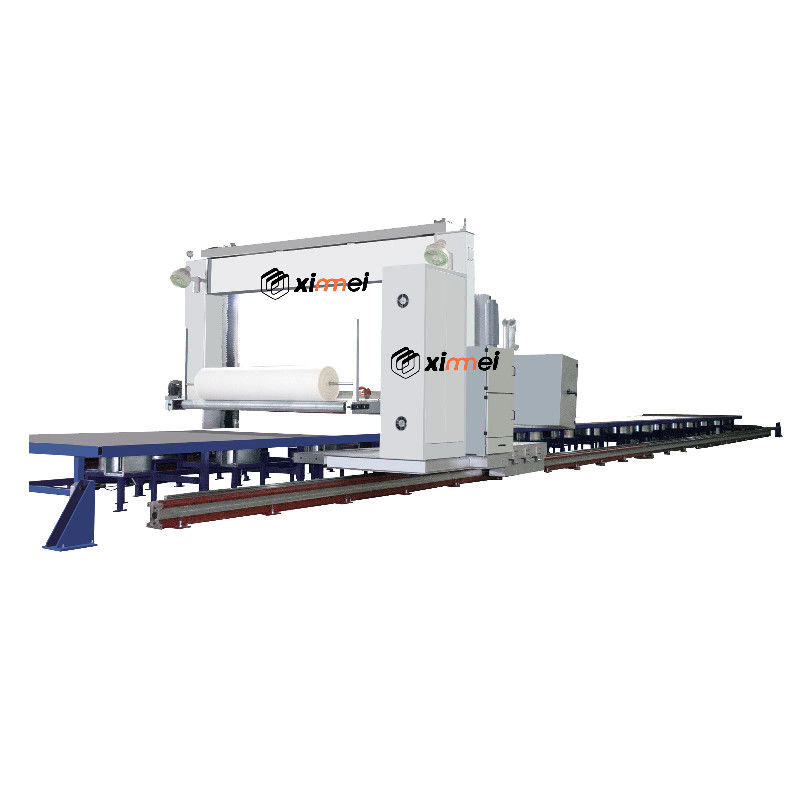
The C517 is a high-precision horizontal splitting machine for unlimited-length foam blocks, designed to slice long foam into thin sheets for lamination. It combines a servo drive, a linear motion guide rail, a vacuum suction platform and automatic knife entry feeding with grinding, so a long block can be cut continuously at a controlled thickness instead of being cut in short sections.
Where a conventional reciprocating slicer relies on a sliding surface and manual knife setting, the C517 puts the cutting head on a linear guide and controls the travel with a servo motor. That combination is what allows a cutting tolerance of ±0.05 mm on thin sheets and a cutting speed adjustable from 0 to 120 m/min, while keeping the machine quiet and the slice surface flat.
What the Machine Does in the Line
Long foam block
Horizontal splitting
Sheet take-off
Lamination
Cutting / packing
The C517 sits between the foam block and the lamination line. A long PU foam block, typically peeled or split from a larger bale, is placed on the vacuum platform and sliced horizontally into sheets from 0.5 mm to 70 mm thick. The sheets then go to a lamination machine to be bonded with PE film, fabric or another substrate, and finally to cutting and packing.
Because the table accepts long blocks, the machine removes the need to cut a block into short pieces before slicing. That matters for two reasons: short pieces produce more end trim and more handling, and every re-clamping step is a chance for the block to shift and the sheet thickness to drift. Cutting long and cutting once keeps the sheet continuous and the thickness consistent along the whole length.
Linear Motion Guide: Why It Changes the Cut
The cutting head travels on a linear motion guide rail rather than on a conventional sliding guide. A linear guide constrains the head in all directions with preloaded bearing blocks, so the knife path stays straight under load and does not lift or skew as the carriage moves. On long cuts, that difference shows up directly in the sheet: straight guide travel produces a flat sheet with parallel faces, while a worn sliding guide produces a sheet that is thin at one end and thick at the other.
It also changes the maintenance picture. Linear guides are lubricated and protected rather than scraped and adjusted, so the geometry stays stable for longer and the machine does not need frequent re-setting of the carriage to keep the cut square.
Straight Travel
Preloaded bearing blocks hold the cutting head on a fixed path, so the blade does not drift over a long stroke.
Stable Geometry
Guide rail alignment is set once and stays consistent, which keeps sheet thickness repeatable shift after shift.
Low Noise, Low Vibration
Rolling contact instead of sliding friction reduces vibration and noise in the workshop.
Servo Control and Cutting Speed
The travel is driven by a servo motor, with cutting speed adjustable from 0 to 120 m/min. Servo control matters on a splitting machine for three reasons. First, the carriage accelerates and decelerates smoothly, so the blade does not shock the foam at the start and end of each stroke. Second, the speed can be matched to the foam grade: soft, low-density foam cuts cleanly at a different feed rate than a denser block. Third, the motion is repeatable, which is what makes the ±0.05 mm tolerance achievable in daily production rather than only in a demonstration.
In practice, operators set the speed together with the thickness and the knife condition. Running faster than the foam and blade can support does not improve output, because the cut quality drops and the sheet has to be rejected. The 0–120 m/min range gives enough headroom to find the best rate for each product rather than forcing one fixed speed across the whole range.
Vacuum Suction Platform and Sheet Quality
Foam is light and compressible, so it moves easily under a cutting force. The C517 uses a vacuum suction platform to hold the block down during the stroke. A stable hold does two things: it prevents the block from being pushed or lifted by the blade, and it keeps the block flat against the table so the sheet thickness is measured from a consistent datum.
Vacuum hold also makes thin-sheet cutting practical. When the target thickness is a fraction of a millimeter to a few millimeters, any movement of the block translates directly into a thickness error. Holding the block flat and still is the precondition for cutting at ±0.05 mm, and it is the reason the machine can run thin sheets at production speed instead of slowing down to compensate for a moving block.
For the vacuum to work, the block surface needs to be reasonably flat and the table surface clean. Operators should check the table before each block and remove foam dust and offcuts, because a single trapped chip creates a leak path and a local low-pressure area that lets the block lift.
Automatic Knife Entry Feeding and Grinding
The machine is equipped with automatic knife entry feeding and automatic grinding. Instead of an operator setting the blade by hand for each thickness change, the knife is fed to the set position and the edge is maintained by the grinding function. That has a direct effect on consistency: a sharp, correctly positioned edge cuts foam cleanly, while a dull edge compresses the foam before it separates, which produces a rough surface and a thickness that springs back after cutting.
Automatic grinding also removes the most common cause of drift between shifts. When the blade is sharpened by hand at irregular intervals, the effective cutting geometry changes a little each time and the operator compensates by adjusting the thickness setting. With the grinding function in the cycle, the edge condition stays within a narrow band, so the thickness setting stays valid.
Operators should still check the blade at the start of each shift and after any abnormal cut. Grinding maintains an edge, it does not repair a chipped or cracked blade, and a damaged blade should be replaced before it marks the sheet or damages the guide.
Technical Specifications
Cutting thickness
0.5–70 mm
Cutting width
2200 mm
Cutting height
1300 mm
Cutting tolerance
±0.05 mm
Cutting speed
0–120 m/min
Main motor power
25 kW
Main unit weight
8 T
Main unit dimensions (L×W×H)
6500 × 3000 × 2600 mm
The figures above define the working envelope: sheets from 0.5 to 70 mm thick, up to 2200 mm wide, from blocks up to 1300 mm high. The ±0.05 mm tolerance applies to thin sheet cutting in the 0.5–3 mm range; thicker sheets have a correspondingly wider practical tolerance. The 25 kW main motor, 8 t machine weight and 6500 × 3000 × 2600 mm footprint define the site and foundation requirements.
Materials and Typical Finished Products
The C517 is built for flexible polyurethane foam blocks. It is used where a long block has to be converted into thin, uniform sheet for further processing, rather than where foam has to be cut into shaped parts. Typical products made from the output include mattress comfort layers, upholstery and furniture padding, automotive interior foam, packaging and technical foam sheets, and the sheet used as the substrate in foam lamination with PE film or fabric.
Foam grade affects how the machine should be set rather than whether it can cut. Lower-density, softer foam needs a sharp edge and a moderate feed to avoid compressing the surface; denser foam tolerates a higher cutting force but rewards a stable hold and a straight guide. Because the machine's thickness range covers both thin laminating sheet and thicker cushioning layers, the same unit can serve several product lines, provided the thickness and speed settings are recorded for each one.
Selection Guide: Matching the Machine to the Product
Five numbers decide whether the standard C517 fits a production plan. Buyers should confirm all five against the products they actually make:
Cutting thickness (0.5–70 mm): the full range the machine can produce. Check both the thinnest and the thickest sheet in the product mix.
Cutting width (2200 mm): the maximum block width. A wider block cannot be cut in one pass, so the block supplier or the upstream cutting step must match this figure.
Cutting height (1300 mm): the maximum block height, which sets the maximum number of sheets that can be taken from one block.
Tolerance (±0.05 mm): applicable to thin sheets in the 0.5–3 mm range. Products with a looser thickness requirement do not need to pay for this level of precision.
Speed (0–120 m/min): the adjustable cutting rate. The practical rate depends on foam density, sheet thickness and blade condition.
It is also worth confirming how the block will be loaded onto the table and how the sheet will be taken off. A 2200 mm wide table needs a handling method that keeps the block flat and square during loading; a block that is dropped or dragged into place can be out of flat before the first cut.
Site Requirements: Power, Floor and Environment
The main motor is 25 kW, and the machine weighs 8 t with a footprint of 6500 × 3000 × 2600 mm. The floor must carry that weight and stay level, because a table that deflects will produce sheets that vary in thickness across the width. A properly designed foundation, isolated from nearby vibrating equipment, is the safest approach for a precision machine of this size.
The site should provide a dedicated power supply with correct earthing and a local isolator, sized for the installed load with a safe margin. Foam dust is unavoidable in a splitting department, so the electrical cabinet should be kept closed and filtered, and the area around the guide rail and the vacuum table should be cleaned regularly. Good general lighting at the cutting table helps operators spot surface defects and blade marks before the sheet moves to lamination.
Installation, Commissioning and Training
Installation begins with the foundation and the leveling of the main frame, followed by the guide rail and the cutting head. The guide rail alignment is the critical step: if it is not straight and parallel to the table, the machine will cut a taper no matter how carefully the thickness is set. After alignment, the vacuum system, the knife feed and the grinding function are checked, and the servo travel is tuned for smooth acceleration and deceleration.
Commissioning then moves to trial blocks at several thicknesses across the range, starting with a thicker sheet and working down to thin sheet. Each trial sheet is measured at several points along its length and across its width, and the thickness setting is confirmed against those measurements. Only when the thin sheets meet the tolerance is the machine released for production.
Operator training covers four points: loading the block flat and square, setting thickness and speed for each product, checking the blade and the vacuum before a run, and stopping the machine safely if the cut sound or the sheet surface changes. Training also covers the daily cleaning routine, which is what protects the guide rail and the vacuum table over years of use.
Operation and Maintenance
Splitting machines live in a dust-heavy environment, and most long-term accuracy problems start with contamination rather than wear. The guide rail, the vacuum table and the knife area should be cleaned at the end of every shift. Foam dust that reaches the bearing blocks is abrasive and will slowly destroy the smooth travel that the whole design depends on.
Each shift: clean the table and the guide area, check the blade for chips, confirm vacuum hold on a test block, check the sheet surface for blade marks.
Weekly: inspect the guide rail and bearing blocks, check the knife feed and grinding mechanism, confirm the servo drive and the travel limits, inspect belts and fasteners.
Periodically: measure a test sheet at several points to confirm thickness repeatability, check the vacuum pump and seals, and review the electrical cabinet for dust ingress.
Spare parts worth holding are blades, blade mounting components, vacuum seals and filter elements. The blade is the part that most directly affects sheet quality, so a worn or damaged blade should be replaced rather than compensated for by changing the thickness setting.
Quality Control and Certification
Each machine is assembled, aligned and run before shipment. Inspection covers the frame and table, the guide rail and carriage, the servo drive and travel, the vacuum system, the knife feed and grinding function, the electrical cabinet and the safety guarding. The machine carries CE certification, and the documentation set includes the operation manual, electrical diagrams and the inspection record.
At the buyer's site, the acceptance test is a set of trial cuts across the thickness range, with measurements taken along the length and across the width of each sheet. A machine that holds its tolerance at the thin end of the range, where the requirement is tightest, will hold it on thicker sheets as well. Repeating the same test after any blade change or guide adjustment keeps the process under control.
Packaging, Delivery and Commercial Terms
Packaging is confirmed with each order, because the machine is 8 t with a 6500 mm overall length and the shipping method affects how it is braced and protected. The guide rail, the knife assembly and the electrical cabinet are protected for transport, and the main frame is secured for lifting.
Delivery time is 45 working days after downpayment. Payment terms are L/C or T/T, the minimum order quantity is one set, and price is quoted on inquiry because the configuration and the destination affect the final figure. Supply ability is 3 sets per season. Buyers should confirm the block width, block height and target thickness range at the quotation stage, so the machine is specified once for the actual product mix.
Frequently Asked Questions
What thickness range can the C517 cut?
From 0.5 mm to 70 mm. The ±0.05 mm tolerance applies to thin sheets in the 0.5–3 mm range; thicker sheets have a correspondingly wider practical tolerance.
What is the maximum block size?
The cutting width is 2200 mm and the cutting height is 1300 mm, so the block must fit within that envelope. Blocks longer than the table are handled as continuous long-block cutting rather than cut into short sections first.
Why does the machine use a linear guide rail?
A linear motion guide keeps the cutting head on a straight, constrained path under load. That produces flat sheets with parallel faces, holds thickness repeatability over long cuts, and runs quieter than a sliding guide.
How fast can it cut?
Cutting speed is adjustable from 0 to 120 m/min through the servo drive. The practical rate depends on foam density, sheet thickness and blade condition.
Does the vacuum platform hold the foam during cutting?
Yes. The platform uses vacuum suction to hold the block flat and still during the stroke, which is essential for cutting thin sheet to ±0.05 mm.
How is the machine installed and supported?
It needs a level foundation for an 8 t machine with a 6500 × 3000 × 2600 mm footprint and a 25 kW supply. Support covers installation and commissioning guidance, operator training and spare parts.
Need precision sheet for your lamination line?
Tell us your block width, block height, target thickness and output requirement, and we will confirm the C517 configuration, delivery schedule and quotation.


 Your message must be between 20-3,000 characters!
 english
 français
 Deutsch
 Italiano
 Русский
 Español
 português
 Nederlandse
 ελληνικά
 日本語
 한국
 العربية
 हिन्दी
 Türkçe
 indonesia
 tiếng Việt
 ไทย
 বাংলা
 فارسی
 polski