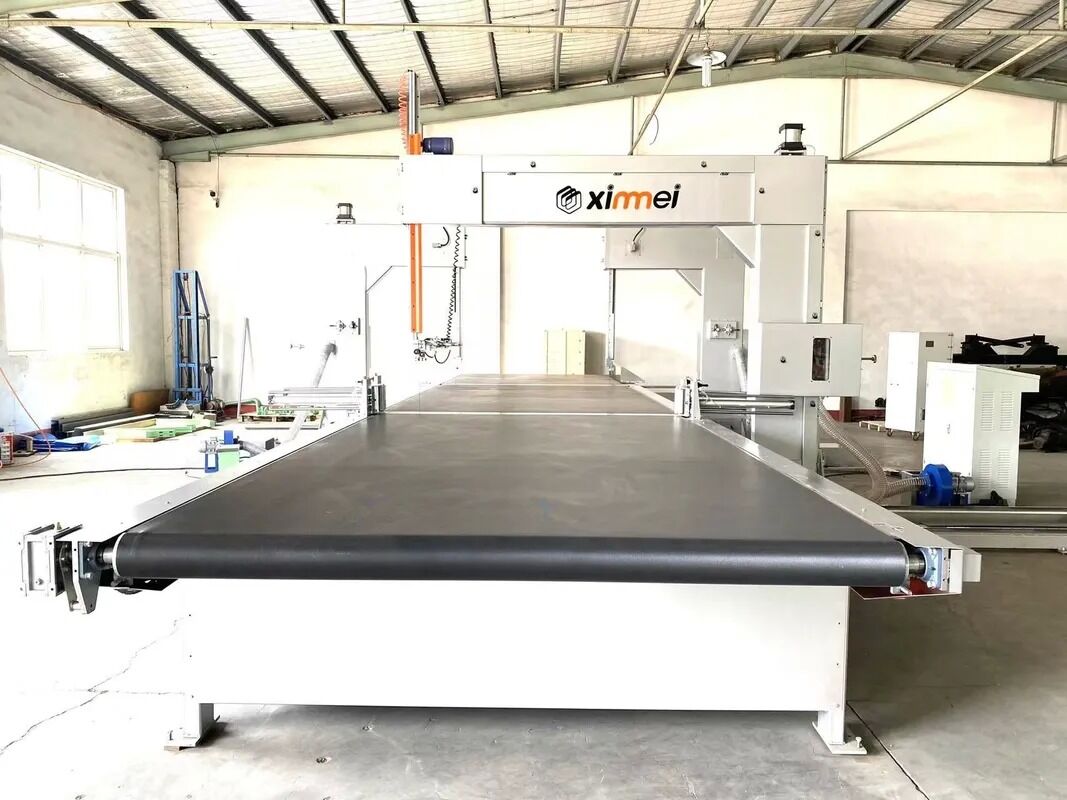
Fully Automatic Vertical Sponge Cutter Foam Profile Cutting Machine for 3000x2200x1250 mm Blocks at 0-50 m/min
The TDPF-03 is a fully automatic vertical sponge cutter that turns whole foam blocks into square and rectangular blanks in one continuous run. The operator types the target length and width on a touch screen; the machine takes over the feed and the vertical cut. There is no drawing file to prepare, no hand marking on the block and no operator pushing foam through a blade.
The working envelope is sized for industrial block production: a 7000×2300 mm feed table, a maximum cutting size of 3000×2200×1250 mm, a cutting speed range of 0-50 m/min and a length and width tolerance of ±0.5 mm. Blanks produced inside that envelope can go straight into lamination, upholstery or packaging assembly without a separate trimming pass.
The machine suits furniture and mattress plants preparing cushion cores, packaging converters cutting shockproof inserts, and footwear or luggage workshops producing EVA components. It works with PU sponge, EVA, PE and EPE pearl cotton, and it produces dimensioned rectangular blanks rather than rough slices that still need squaring.
Where a manual vertical cutter depends on the eye and the experience of one operator, the TDPF-03 fixes the dimension in the control system and repeats it for the whole batch. That change is what makes the machine usable by a new operator after a short introduction, and what keeps the output of the first shift and the last shift of the week at the same size.
What the Machine Does in the Line
A production cycle on the TDPF-03 is short and predictable, which is the point of the design. The steps below describe a normal block-to-blank run.
Load the block. The PU, EVA, PE or EPE block is placed on the 7000×2300 mm table and pushed against the reference edge, with the base sitting flat.
Enter the size. The target length and width are typed on the touch screen. No CAD file and no programming step are involved.
Start the cycle. The machine positions the block relative to the blade and begins the vertical cut.
Cut continuously. The feed advances while the band knife runs, so one blank follows the next without a manual re-clamp between pieces.
Collect the blanks. Finished pieces leave from the outfeed side, square and stacked for the next process.
Change size. A different length and width are entered for the next order and the cycle restarts; there is no fixture to re-set.
In a plant that cuts several sizes per shift, step six matters as much as the cutting itself. On a manual machine a size change means moving a fence, checking the setting with a tape measure and running a trial piece. On the TDPF-03 the new value on the screen is the setting.
Machine Structure and Working Principle
Four assemblies carry the work: the feed table, the vertical band knife head, the digital control system and the driven feed. Each of them supports the same result — a square blank with repeatable length and width.
7000×2300 mm feed table: the long table supports the block along the whole cut, so a large block does not need to be re-supported halfway through and the finished face stays flat.
Vertical band knife head: a continuous band knife cuts vertically through the full 1250 mm block height, producing a flat face and a square corner in a single pass.
Touch screen control: the operator enters length and width, and the control system works out the cutting sequence and runs it automatically.
Digital dimension setting: dimensions are held electronically instead of by mechanical fences or limit blocks, so the value cannot drift with machine vibration.
Servo-driven feed: the block is moved by a controlled drive rather than by hand, which gives smooth acceleration and consistent dimensions across a batch.
Continuous cutting cycle: the machine completes the pass without pausing between pieces, which is the main structural difference from a manual vertical cutter of the same table size.
Accuracy is decided by three mechanical details more than by the electronics. The band knife must be tensioned and tracking correctly, the block must sit flat on the table, and the base of the block must be square. The control system can position a cut precisely, but it cannot correct a block that is tilted or a base that is sloped.
The machine is deliberately simple in use. There is no contour path to generate, no nesting software and no tool path to verify. The operator works with two numbers, and the same two numbers produce the same blank on the next shift.
Fully Automatic Control and Digital Dimension Setting
Size Entry on a Touch Screen
Length and width are typed in and stored by the control system; the cutting sequence runs from those two values.
No Drawing File Required
There is no CAD drawing, no nesting file and no programming step, so the machine is independent of office software.
±0.5 mm on Both Axes
Length and width are held electronically, so there is no fence to slip and no setting to re-check after a size change.
On a manual vertical cutter the width is set with a mechanical fence and checked with a tape measure. Small errors repeat on every piece, and the fence creeps as the machine vibrates through a shift. The TDPF-03 removes that variable: the value in the control system is the setting, and the same value is used for the whole batch.
Digital setting also changes how the machine is run. Sizes can be entered in advance for the next order while the current block is still being cut, which shortens the gap between two jobs. For a plant cutting cushions in several widths for one customer, that is a practical gain on every shift.
Continuous Cutting and Output Logic
A manual vertical cutter loses time in places that are easy to overlook: marking each piece, clamping the block, guiding it through the blade by hand, releasing the clamp and measuring the result. None of those steps removes material, but all of them sit inside the cycle time.
On the TDPF-03 those steps are outside the cut. The size is already in the control system, the feed is driven, and the cut runs to the end of the pass. The operator handles the block at the start and the blanks at the end, and between those two points the machine works on its own.
Real output therefore depends on three things rather than on the machine alone:
Cutting speed setting: the 0-50 m/min range lets the speed follow the material. Low density EPE runs at the higher end, dense PU or blocks close to the 1250 mm height limit run slower and cleaner.
Block handling: the time to load a block and clear blanks from the outfeed side sets the pace when the cut itself is short.
Blank size: small blanks mean more pieces per block and more handling; large cushion cores mean fewer, heavier pieces and more attention to lifting.
The machine does not need constant supervision during the cut, which means one operator can load, set the size and collect blanks without standing at the blade. That is also the main safety gain, described in the operation section below.
Technical Specifications
Item
Parameter
Model
TDPF-03
Table size (L×W)
7000×2300 mm
Cutting size (L×W×H)
3000×2200×1250 mm
Cutting speed
0-50 m/min
Cutting tolerance (L×W)
±0.5 mm
Motor power
7 kW
Machine weight
4000 kg
Overall dimension (L×W×H)
7000×6000×2500 mm
Control system
Touch screen with digital length and width setting
Operation mode
Continuous cutting without a pause between pieces, no CAD drawing needed
Certification
CE
The cutting size above is the maximum block that can be processed in one pass. The table is longer than the maximum cutting length because the block has to be supported before and after the cut, and because the outfeed side needs room for the finished blanks.
Materials and Typical Finished Products
The machine is built for soft foam materials used across furniture, packaging and footwear production. Each material behaves differently at the blade, and the cutting speed is set accordingly.
PU sponge: flexible polyurethane foam in the densities used for cushioning, mattress layers and upholstery. Dense PU cuts cleaner at a moderate speed.
EVA: closed-cell foam for shoe components, luggage lining and sports mats, where a square edge and a stable dimension matter for the next assembly step.
PE: polyethylene foam for protective packaging, carton dividers and construction joint filler.
EPE pearl cotton: low density packaging foam for electronics and fragile goods, cut at the higher end of the speed range.
Typical finished products from this machine include:
Sofa cushion cores, armrest pads and backrest blanks in PU sponge.
Mattress support layers and rectangular cores cut to a fixed length and width.
EPE and PE inserts for shockproof packaging, box dividers and corner protection.
EVA blanks for insoles, lining and luggage shells.
Pre-cut foam blanks for laminating, slicing and profiling lines.
PE blocks for joint filler and acoustic separation in construction.
The limit of the machine is shape, not material. It produces square and rectangular blanks; curved, profiled or 3D parts need a contour cutting machine, which is covered in the selection section.
Cutting Accuracy and What It Changes Downstream
A tolerance of ±0.5 mm on length and width sounds like a machine shop figure, but its value is visible one or two processes later, in three common cases.
Furniture and upholstery. A cushion core that is 1 mm oversize will not sit cleanly inside a sewn cover. The cover either pulls at the seams or the core has to be trimmed by hand. Holding ±0.5 mm at the cutting stage removes that manual correction and keeps sewing output stable.
Packaging. Inserts that vary in width either fall out of the carton or have to be forced in, which slows the packing line and damages the insert edge. A consistent width lets the insert drop into place and keeps the carton closing at the planned rate.
Lamination. Uneven blanks create pressure differences in the press, and those differences appear as glue lines or bubbles after bonding. Square, equal-thickness blanks spread the pressure evenly and reduce rejects at the laminating stage.
Two conditions still apply. The block must be loaded flat on the table and against the reference edge, and the base of the block must be square. A block with a sloped or damaged base will reproduce that slope in every blank, whatever the control system is set to. If block bases arrive uneven, they should be squared on a horizontal cutter before vertical cutting.
Selection Guide: Vertical Cutter, Splitting Machine or Contour Cutter
Buyers often compare three machine types that look similar in a catalogue but produce different things. The table below is a practical way to place the TDPF-03 against the alternatives.
Machine type
What it produces
Choose it when
TDPF-03 vertical sponge cutter
Square and rectangular blanks cut to a set length and width
The product is a block-shaped core, insert or pad, and the priority is repeatable dimensions at a steady rate
Horizontal splitting machine
Thin sheets sliced from the height of a long block
The product is a sheet for lamination, mattress layers or roll goods
CNC contour cutting machine
Curved, profiled and 3D shapes with a cutting path
The product has a shape that cannot be produced with straight vertical cuts
The three machines are often used in the same plant rather than as alternatives. A common sequence is: block foaming, curing, splitting into sheets on a horizontal machine, vertical cutting of cores on the TDPF-03, then lamination and final assembly. Where a plant already owns a contour cutter, the TDPF-03 still earns its place for the simple rectangular work, because straight cuts on a contour machine consume programming time and blade life for a job that needs neither.
Site Requirements: Power, Floor, Dust and Space
The machine is a floor-standing unit of 4000 kg with a footprint of 7000×6000×2500 mm, so a few site details should be confirmed before delivery.
Power supply: a 7 kW supply matched to the local voltage and frequency. The electrical configuration is confirmed at order stage for the destination market.
Floor: a level concrete floor able to carry the machine weight and the weight of a full block, with no slope that would let the block creep during the cut.
Clearance: working space around the footprint for loading blocks on the infeed side and removing blanks on the outfeed side, plus access for the control cabinet.
Dust: foam dust is produced at the blade, so the area should be kept clear and cleaned regularly; a collection point near the cutting zone keeps the table surface clean.
Environment: a dry, covered area. The main frame is treated against rust for shipment, but a damp or open yard will still affect guide surfaces and electrical parts.
Block storage belongs next to the machine, not on it. Blocks stacked against the table edge are a common cause of a tilted load, and a tilted load is the first source of a dimension error that the control system cannot correct.
Installation, Commissioning and Training
A layout drawing, a wiring diagram and an English operation manual are supplied with the machine. Commissioning support is provided remotely, and on-site installation with operator training can be arranged on request.
Installation follows four stages. The machine is positioned on the prepared floor and levelled; the electrical supply is connected and checked against the supplied diagram; the band knife is fitted, tensioned and tracked; and a trial block of each material is cut to confirm the dimension settings against the finished blank. The trial cut is the step that turns a specification sheet into a working setting for the customer's own foam.
Training covers loading position, size entry, the cutting cycle, blade tension checks and the daily cleaning routine. A new operator normally reaches saleable output within the first shift, because the machine needs two numbers and a correctly loaded block rather than a learned skill.
Operation, Safety and Shift Routine
The cutting action is fully automatic, so the operator does not hold or guide the block while the band knife is moving. Dimensions are entered before the cycle starts, and the machine runs the cut without manual intervention. That separation between setting and cutting is the main safety advantage over a hand-fed vertical cutter.
Three rules cover the main risks in daily use:
Keep hands clear of the cutting zone while the machine is running, including during the return of the head at the end of a pass.
Keep the table surface clear of off-cuts that could tilt the block or lift it off the reference edge.
Check band knife tension and tracking at the start of every shift, before the first block is loaded.
At the end of a shift, the usual routine is to clear foam dust from the table and guide surfaces, confirm that no off-cut is left under the blade path, and switch off the supply. Because dimension setting is digital, there is no fence to re-check in the morning: the stored value is still the setting.
Maintenance and Spare Parts
Maintenance on the TDPF-03 is short and mechanical. Four items cover normal operation:
Every shift: band knife tension and tracking, plus cleaning of foam dust from the table and guide surfaces.
Weekly: lubrication of the moving parts according to the manual, and a check of the feed drive for smooth travel.
Monthly: inspection of the blade for dullness, cracks or missing teeth, and a check of the electrical cabinet for dust build-up.
As required: replacement of the band knife and worn guide components.
Spare band knives and guide components can be shipped with the machine, so a worn part is replaced from stock instead of waiting for an import delivery. For a plant running one machine, that decision is usually worth taking at order stage: a dull blade is a quality issue, and a missing spare is a lost shift.
Quality Control and Certification
Every machine is assembled, aligned and run before shipment. Cutting dimensions are checked on sample foam of each material type, and the control system is tested through a full size-change sequence to confirm that the digital setting matches the finished blank.
The electrical configuration is CE compliant for European and other export markets. Documentation supplied with the machine includes the layout drawing, the wiring diagram and the English operation manual, which is also the reference for the maintenance intervals described above.
Packaging, Delivery and Commercial Terms
The main frame is shipped with rust-proof treatment and a protective film. The touch screen, control cabinet and small spare parts are packed in wooden cases, and the machine is secured for container transport.
Standard delivery is 45 working days after the down payment is confirmed, shipped from Qingdao port. Payment terms are T/T or L/C, minimum order quantity is one set, and supply ability is three sets per season. Price is quoted against the required configuration, the destination port and the spare parts list, because those three items change the packing plan and the delivery schedule.
When requesting a quotation, the useful details are: foam material, block size, target blank dimensions, required output per shift and the destination port. With those five points, the table configuration, the control system, the spare parts list and the delivery date can be confirmed in one reply.
Frequently Asked Questions
Q: Can the TDPF-03 cut curved or profiled shapes?
A: No. It produces square and rectangular blanks with straight vertical cuts. Curved or profiled parts require a CNC contour cutting machine.
Q: Do operators need drawing or programming skills?
A: No. Length and width are typed on the touch screen and the cycle runs automatically. There is no CAD file, drawing or programming step.
Q: How long does a size change take?
A: Seconds. New dimensions are entered on the screen, and there is no mechanical fence or fixture to re-set. That is where a manual cutter usually loses time.
Q: Will the dimensions drift during a long batch?
A: Not from the setting side, because the values are held electronically. Drift usually comes from the block shifting on the table, so keep the table clear of off-cuts and load the block flat against the reference edge.
Q: Can it cut low density EPE without compressing the foam?
A: Yes, at a reduced speed. Soft, low density foam compresses under the blade, so run slower and check the first blank of each block before increasing the speed.
Q: What if my block is larger than 3000×2200×1250 mm?
A: It cannot be processed in one pass on this model. Either specify a larger table configuration or pre-cut the block on a horizontal splitting machine.
Q: What is needed on site before installation?
A: A level concrete floor able to carry 4000 kg, a 7 kW supply matched to your voltage and frequency, and clear space around the 7000×6000×2500 mm footprint.
Request a Quotation for the TDPF-03
Tell us your foam material, block size, target blank dimensions and daily output. We will confirm the table configuration, the control system, the spare parts list and the delivery schedule, and we can arrange a cutting test on your own material at our Qingdao plant or by video.


 Your message must be between 20-3,000 characters!
 english
 français
 Deutsch
 Italiano
 Русский
 Español
 português
 Nederlandse
 ελληνικά
 日本語
 한국
 العربية
 हिन्दी
 Türkçe
 indonesia
 tiếng Việt
 ไทย
 বাংলা
 فارسی
 polski