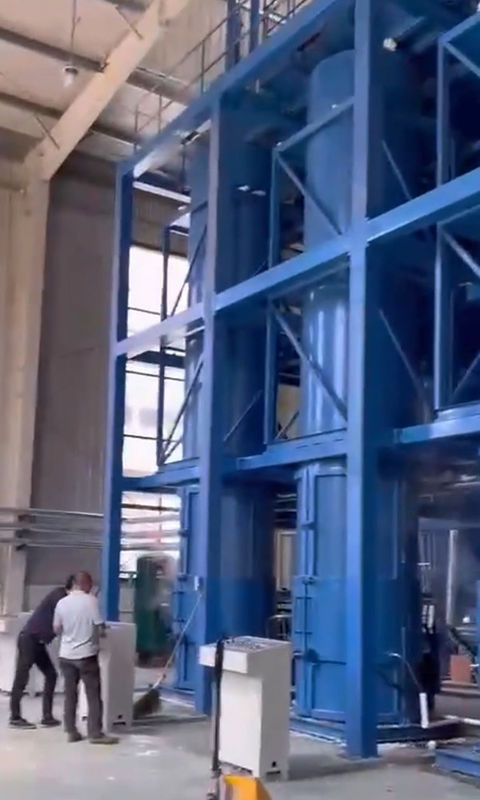
15m³ Mixing Tank Rebonded Foam Machine with Triple-Mold 9 Molds/h Output
TDPF-04 Triple-Mold Cylinder Rebonded Foam Line for Carpet Underlay
The TDPF-04 turns waste PU sponge, EVA, PE, EPE and rubber offcuts into cylindrical rebonded foam blocks. The line crushes the waste, mixes it with binder in a 15 m³ tank, fills cylinder molds under pressure, and cures the block with steam or natural drying. Production density is adjustable from 50 to 300 kg/m³, the finished block measures φ1000–1300 mm × 1200–2200 mm, and the triple-mold configuration runs up to 9 molds per hour.
The block is then peeled into continuous sheet and laminated with PE film or fabric for carpet underlay, floor mats and shoe cushion materials. This page focuses on the two things that decide if the line makes money: density consistency across the block, and mold cycle planning across three molds.
A large mixing volume lets the binder coat the crushed waste evenly before the mold is filled, which is the base of a consistent density.
50–300 kg/m³ density
One line covers soft underlay grades through high-density blocks by changing the waste mix, binder ratio and fill weight.
9 molds per hour
The triple-mold configuration runs three cylinder molds in sequence, with single, double and quadruple options on the same platform.
Model: TDPF-04
Mixing tank volume: 15 m³
Production density: 50–300 kg/m³
Productive capacity: 9 molds/h (triple)
Foam size: φ1000–1300 mm × L1200–2200 mm
Total motor power: 75 kW
Machine weight: 60,000 kg
Certification: CE
Core Advantages
Waste becomes a saleable block: PU, EVA, PE, EPE and rubber offcuts replace virgin material, so the raw material cost follows the waste market rather than the foam market.
Density range from soft to hard: 50–300 kg/m³ covers carpet underlay, shoe cushion and acoustic grades on one platform.
Even binder distribution: the 15 m³ tank gives the crushed waste and binder enough volume to mix before filling, which limits binder-rich and binder-poor patches in the block.
Triple-mold output: three molds run in sequence for up to 9 molds per hour, and the same frame supports single, double and quadruple configurations.
Cylinder format for peeling: the round block can be peeled into continuous sheet, which suits lamination with PE film or fabric.
Heavy frame for continuous work: a 60,000 kg structure and 75 kW total motor power are sized for long shifts, not short batches.
From Waste to Cylinder Block
Collect and sort. Keep PU, EVA, PE, EPE and rubber waste separated by type so the blend can be repeated.
Crush. Reduce the offcuts to a consistent granule size. A mixed granule size fills the mold unevenly and shows up as density variation.
Add binder. Dose the binder against the granule weight, not against the mold volume.
Mix. Run the 15 m³ tank until the binder is distributed across the batch. Sampling at the start and end of the discharge shows if the mix is even.
Fill the mold. Fill the cylinder mold under pressure so the granules pack to the target density.
Cure. Steam or natural drying bonds the binder and granules into a solid cylinder.
Demold and peel. Remove the block, then peel it into continuous sheet for lamination.
The first three steps decide the density; the mold and cure only preserve it. If the granule size or binder dose changes, the block changes, even when the mold setting stays the same.
Density Control from 50 to 300 kg/m³
Density is set by three variables: the bulk density of the crushed waste, the binder ratio, and the fill weight in the mold. On a cylinder mold of fixed volume, the fill weight is the direct control, but it only works if the granule size and binder dose are stable from batch to batch.
Density band
Typical use
What to watch
50–100 kg/m³
Carpet underlay, packaging cushion
Binder-rich spots and soft corners; keep the fill weight low and even
100–180 kg/m³
Floor mats, acoustic panels
Granule size consistency and mold fill pattern
180–240 kg/m³
Shoe midsole, vibration buffer
Compression during fill and cure time
240–300 kg/m³
High-density blocks and technical parts
Binder dose, fill weight and steam cure uniformity
Check density on a sample cut from the upper, middle and lower part of the block, not from one corner. A block that passes at the surface and fails in the centre will peel into sheet with variable thickness, and the problem only appears at the customer.
Mixing and binder station: the 15 m³ tank distributes binder across the batch before mold filling.
Waste Mix and Binder Ratio
The waste mix sets the base density before binder is added. A batch of light PU sponge and a batch of dense EVA offcut do not weigh the same in the same mold, so the fill weight has to follow the mix. Keep a simple record of the waste type, granule size and bulk density for each batch; without it, the operator is adjusting blind.
Binder ratio is the second control. Too little binder leaves loose granules and a block that crumbles at the cut; too much binder fills the gaps, pushes density up and makes the block harder and less resilient. Start from a fixed ratio for each density band and change one variable at a time during the trial.
Mold Fill and Block Roundness
The cylinder mold has to fill evenly around its section. A single fill point packs material on one side and leaves the other side loose, which shows up as an oval block and a sheet that varies in thickness after peeling. Check roundness with a tape at two cross-sections, and check the block weight against the target for its volume.
A block that is round but light will peel with a soft surface; a block that is heavy but oval will peel with thickness variation. Both are caught before the peeling machine, and both are less costly to fix at the mold than at the customer.
Steam Curing and Demolding
Steam curing sets the binder and gives the block its strength. Natural drying is possible, but it takes longer and depends on the plant climate, so the usual choice is steam for a predictable cycle. The cure is complete when the block holds its shape at demolding and the cut surface shows granules bonded rather than loose.
Demolding too early gives a block that deforms under its own weight; demolding too late wastes cycle time. The operator judgement is backed by a simple check: press the block surface at the mold opening. If it springs back without leaving loose granules, the block is ready to move.
Cylinder mold and press section: fill under pressure, then cure and demold.
Triple-Mold Capacity and Cycle Planning
The triple-mold line runs three cylinder molds in sequence and reaches up to 9 molds per hour. The same platform is available as single, double or quadruple, with nominal capacity of 3, 6, 9 and 12 molds per hour.
Plan the shift around the mold cycle rather than the crusher. The crusher can usually run ahead and buffer granules; the mold and cure station sets the output. At 9 molds per hour and 80% uptime, the line produces roughly 58 molds in an eight-hour shift.
Buffer the granules: keep enough mixed material ahead of the molds to cover a crusher halt.
Stagger the molds: offset fill, cure and demold so the operator is not waiting on one mold at a time.
Keep the demold window tight: a block left in the mold blocks the next fill.
Technical Parameters
Parameter
Value
Model
TDPF-04
Mixing tank volume
15 m³
Production density
50–300 kg/m³
Productive capacity
9 molds/h (triple)
Foam size
φ1000–1300 mm × L1200–2200 mm
Total motor power
75 kW
Machine weight
60,000 kg
Certification
CE
Density, block size and mold count define the configuration. Confirm the waste mix and the required density band before ordering, because both affect the crusher, the binder system and the mold fill settings.
Primary Applications
Carpet underlay: rebonded sheet as padding for residential and commercial flooring.
Floor mats: shock-absorbing mats for gyms, workshops and entrances.
Shoe materials: cushion sheet for midsoles and lining components.
Acoustic panels: recycled foam for sound absorption in rooms and vehicles.
Vibration buffer: pads for equipment and packaging.
Packaging cushion: low-density blocks peeled into protective sheet.
Construction padding: underlay and cushion layers for flooring systems.
Downstream: Peeling and Lamination
The cylinder block is peeled into continuous sheet on a peeling machine, then laminated with PE film or fabric. The bore quality and density uniformity of the block decide the sheet thickness tolerance, so the rebonding line and the peeling line should be planned as one process.
Finished cylinder block ready for peeling and lamination.
Line Layout and Site Requirements
The line weighs 60,000 kg and draws 75 kW in total, so the floor and the power supply are the first layout questions. Keep the crusher, mixing tank and mold station in a straight flow, with space for waste storage before the crusher and for cured blocks after demolding.
Floor: level, load-bearing and able to carry the frame plus a full mold.
Power: dedicated supply for 75 kW total; confirm local voltage and frequency before the order.
Steam: a stable steam supply if the line cures with steam; confirm the connection during layout.
Access: crane or forklift access for mold handling and block removal.
Installation, Operation and Safety
Installation starts with the frame, then the mixing tank, then the mold station. After mechanical installation, run an empty cycle on each mold and check the fill, press and demold sequence before any material is loaded.
Commissioning then moves to a trial batch: crush a known waste mix, dose the binder, fill one mold, cure and cut a sample. The sample density is the baseline for the shift.
Safety points for the line:
Lock out the crusher before clearing a jam.
Keep hands clear of the mold press and the demold area.
Use eye and dust protection around the crusher and the mixing tank.
Keep the area around the steam connection clear.
Maintenance and Quality Control
Interval
Task
Each shift
Clean the mixing tank discharge, check the mold surface and the press guards
Weekly
Check crusher blades, binder pump and mold alignment
Monthly
Check the frame anchors, steam connections and electrical cabinet
As worn
Replace crusher blades and mold seals
Quality control is a density sample from each batch plus a visual check for binder spots, loose granules and block roundness. Record the waste mix, binder dose, fill weight and density in one log, so a later complaint can be traced to a batch.
Packaging and Delivery
The line is a 60,000 kg project, so shipment is planned as break-bulk or flat-rack cargo with the frame braced and the molds protected. Packaging is confirmed with each order because the right packing depends on the shipping method and destination port. Delivery time is 45 working days after downpayment; payment terms are L/C or T/T and price is quoted on inquiry.
Video: Cylinder Rebonded Foam Line in Operation
Watch the line: waste crushing, binder mixing and cylinder mold production for 50–300 kg/m³ rebonded foam blocks.
PU sponge, rubber, PE, EVA and EPE offcuts. Keep the types separated so the blend and the density can be repeated.
Q2: What density range can it produce?
50–300 kg/m³, set by the waste mix, binder ratio and fill weight. High-density blocks need tighter control of granule size and cure.
Q3: How many blocks per hour?
Up to 9 molds per hour in the triple configuration. Single, double and quadruple versions run at 3, 6 and 12 molds per hour.
Q4: What block size does the standard mold make?
φ1000–1300 mm diameter and 1200–2200 mm length. Confirm the size at the quotation stage because the mold is built to the block.
Q5: What can be made from the block?
The block is peeled into continuous sheet and laminated with PE film or fabric for carpet underlay, floor mats, shoe cushion and acoustic products.
Q6: What is the delivery time and support?
Delivery is 45 working days after downpayment. Support covers installation guidance, commissioning, operator training, remote assistance and spare parts. The line is CE certified.
Request a TDPF-04 Line Assessment
Send us your waste mix, target density and required block size. Our engineers will confirm the mold count, mixing tank configuration and commissioning plan for your plant.


 Your message must be between 20-3,000 characters!
 english
 français
 Deutsch
 Italiano
 Русский
 Español
 português
 Nederlandse
 ελληνικά
 日本語
 한국
 العربية
 हिन्दी
 Türkçe
 indonesia
 tiếng Việt
 ไทย
 বাংলা
 فارسی
 polski