Product Details
Place of Origin: Qingdao
Brand Name: Xinmeiteng
Certification: CE
Model Number: TDP-10
Payment & Shipping Terms
Minimum Order Quantity: 1 Set
Price: Inquiry
Packaging Details: TO BE DETERMINED
Delivery Time: 45 working days after downpayment
Payment Terms: L/C,T/T
Supply Ability: 3 sets per season
Foaming Size: |
2100*1800*1000 Mm |
Stirring Volume: |
15 M³ |
Stirring Rate: |
40 R/min |
Productive Capacity: |
3 Blocks/h |
Motor Power: |
33 KW |
Machine Weight: |
8000 Kg |
Foaming Size: |
2100*1800*1000 Mm |
Stirring Volume: |
15 M³ |
Stirring Rate: |
40 R/min |
Productive Capacity: |
3 Blocks/h |
Motor Power: |
33 KW |
Machine Weight: |
8000 Kg |
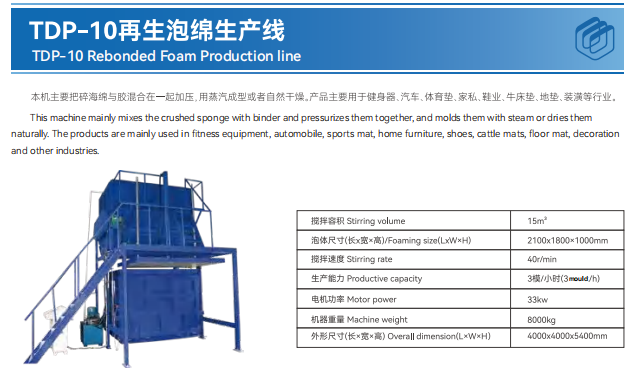
The TDP-10 forms rebonded foam blocks of 2100*1800*1000 mm at 3 blocks per hour. A 15 m³ mixing tank feeds the mould at 40 r/min, the line runs on a 33 kW motor, machine weight is 8000 kg and the overall size is 4000*4000*5400 mm. The line is CE certified.
A fixed block size is a commercial decision as much as an engineering one. If the block matches what the cutting line and the customer expect, there is no trimming, no re-cutting and no waste at the edges. The TDP-10 is built around a 2100*1800*1000 mm mould, so every block is the same size and the downstream cutting plan does not change from batch to batch.
Every block comes out at the same size, so the cutting plan does not change between batches.
Output is a cycle figure: fill, cure, demould and return the mould.
Blocks match the downstream cutter, so there is no edge waste to re-process.
Output is a staging question. If the cured block is not moved promptly, the mould waits and the third block of the hour slips into the next one.
Trimming is the hidden cost in recycled foam. If blocks arrive in random sizes, the cutting line has to square them first, and the offcuts go back to the shredder. That is labour, machine time and material all spent before a sellable sheet exists. A fixed 2100*1800*1000 mm block removes that step for plants whose downstream equipment is set up for that size.
A fixed size also makes output quotable. Three blocks per hour is an easy number to plan a shift around, and it converts directly into square metres of finished sheet once the cutting plan is known. Sales can quote a delivery date from the block count rather than from a guess.
The constraint is flexibility. A single mould size suits a plant with a stable product mix; a plant that changes block sizes weekly needs a different mould arrangement. That is a purchasing decision to make before the order, not after.
| Parameter | Value |
|---|---|
| Model | TDP-10 |
| Foaming size | 2100*1800*1000 mm |
| Stirring volume | 15 m³ |
| Stirring rate | 40 r/min |
| Productive capacity | 3 blocks/h |
| Motor power | 33 kW |
| Machine weight | 8000 kg |
| Overall dimension | 4000*4000*5400 mm |
| Certification | CE |
| Symptom | Likely cause | Action |
|---|---|---|
| Block density uneven | Mixing time too short or binder dosing uneven | Extend the mixing cycle, check the dosing pump and spray pattern |
| Block collapses after demould | Binder ratio too low for the shredded foam | Check the binder ratio and give the block its full cure time |
| Foam not bonding in the core | Shredded foam too coarse or binder coverage poor | Reduce shred size, check spray coverage across the tank |
| Block sticks in the mould | Release agent missed or worn off | Re-apply release agent and check the mould surface |
| Output below 3 blocks per hour | Cure time or mould staging delay | Stage moulds so filling does not wait for demoulding |
| Drive trips under load | Mould over-filled or drive fault | Cut the fill weight, check motor current against the 33 kW rating |
Foaming faults show up after demoulding, when the block is already made. Check the mix and the binder dosing before the fill, and one wasted batch is avoided.
Plan the shift around the cycle: shred supply, binder dosing, fill, cure and demould. The three-block hour only happens when the staging area is clear and the shredder keeps up with the tank.
Safety on a foaming line is mostly binder handling and moving blocks. Keep the dosing area ventilated, and use a lift or a block grab for a cured block rather than dragging it across the floor.
The mould is the part that decides whether the block size stays on spec. Check the mould surface, the sealing and the release agent at the start of each shift. A worn seal lets foam flash into the joint, and the block comes out oversize at one edge.
The mixing and dosing side decides density, and density decides whether the block sells as the grade it was made for. Calibrate the dosing pump each shift and clean the tank at the end of the run.
The line ships in export packing with the tank, mould station and panel separated and braced. At 8000 kg and 4000*4000*5400 mm, plan the container loading and the access at the receiving site before the shipment date.
Delivery is 45 working days after downpayment, payment by T/T or L/C, minimum order one set. Spare seals, dosing parts and remote commissioning support ship with the line.
A: 2100*1800*1000 mm, the same size on every cycle.
A: 3 blocks per hour, set by the fill, cure and demould cycle.
A: A 15 m³ tank stirred at 40 r/min, one batch per block.
A: 33 kW motor, 8000 kg machine weight, 4000*4000*5400 mm overall.
A: Discuss it before the order; changing mould size afterwards costs more than specifying it correctly once.
Tell us the foam type, block or roll size, target sheet thickness and expected output per shift. We will confirm the machine configuration, quote it and share the delivery schedule. Spare blades, guide parts and remote commissioning support are available with every order.