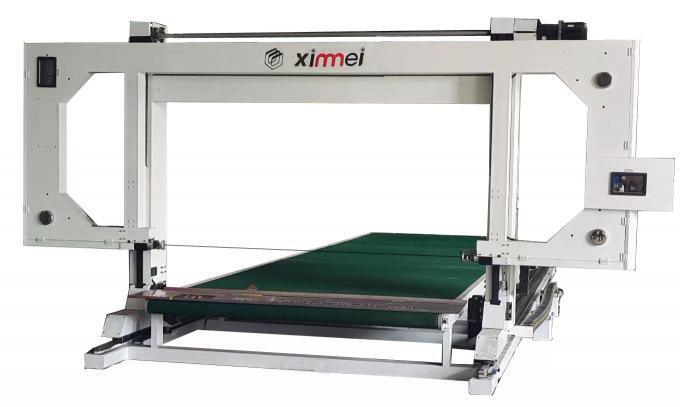
Product Details
Place of Origin: Qingdao
Brand Name: Xinmeiteng
Certification: CE
Model Number: TDPO-2.2
Payment & Shipping Terms
Minimum Order Quantity: 1 Set
Price: Inquiry
Packaging Details: TO BE DETERMINED
Delivery Time: 45 working days after downpayment
Payment Terms: L/C,T/T
Supply Ability: 3 sets per season
Cutting Height: |
1300 Mm |
Cutting Size: |
6000*2100 Mm |
Blade Speed: |
0-70 M/min |
Precision Tolerance: |
±0.5 Mm |
Minimum Cutting Radius: |
10 Mm |
Motor Power: |
8.5 KW |
Cutting Height: |
1300 Mm |
Cutting Size: |
6000*2100 Mm |
Blade Speed: |
0-70 M/min |
Precision Tolerance: |
±0.5 Mm |
Minimum Cutting Radius: |
10 Mm |
Motor Power: |
8.5 KW |
The TDPO-2.2 cuts profiles from blocks up to 1300 mm high. The cutting table is 6000*2100 mm, the revolving loop blade turns ±360° in the cut, blade speed runs 0-70 m/min, precision is ±0.5 mm and the machine weighs 3.5 t on a CE certified frame with an 8.5 kW drive.
Tall blocks are the test of a contour machine. As the blade works at 1300 mm, the upper part of the blade has more unsupported length, and any flex shows up as a profile that is not square through the height. A 3.5 t frame and a guided loop blade are what keep the cut vertical from the table to the top of the block.

Full mattress-height blocks are profiled without being split first.
Mass and stiffness keep the blade vertical through the full block height.
The profile direction changes without lifting the blade out of the block.


On a tall block, check squareness at the top as well as at the table. A part that measures right at the bottom and off at the top points to blade flex or a block that is not square, not to the drawing.
A loop blade cutting at 1300 mm has a long unsupported span. The tension has to be right: too slack and the blade wanders in the cut, too tight and the joint is loaded. Both show up as a profile that is not square through the height, which is the most common complaint on tall block work.
The block itself matters as much as the machine. A block that is 20 mm out of square will produce a part that is 20 mm out at the top even if the blade runs perfectly. Squaring the block on a vertical cutter before profiling is the cheapest quality step in the process.
Frame stiffness is the last piece. A 3.5 t structure resists the load the blade puts into the machine when it turns through a tight radius at full height. On a lighter frame that load deflects the blade line and the error appears at the top of the part.

| Parameter | Value |
|---|---|
| Model | TDPO-2.2 |
| Cutting size | 6000*2100 mm |
| Cutting height | 1300 mm |
| Minimum cutting radius | 10 mm |
| Band blade speed | 0-70 m/min |
| Blade turning angle | ±360° |
| Precision tolerance | ±0.5 mm |
| Total motor power | 8.5 kW |
| Machine weight | 3.5 t |
| Certification | CE |


| Symptom | Likely cause | Action |
|---|---|---|
| Profile drifts from the drawing | Blade tension dropped or guide worn | Re-tension the blade, check guide clearance, re-cut a test piece |
| Corner radius comes out oversized | Blade too wide for the radius or speed too high | Fit the micro tooth loop blade and reduce the blade speed |
| Torn edges on soft foam | Blade speed mismatched to the foam grade | Adjust blade speed inside 0-70 m/min for latex and memory foam |
| Profile not square through the height | Block not square on the table | Square the block before loading and check table alignment |
| Program stops mid-cut | Nesting file error or limit switch tripped | Check the file and the limit switch, then re-run from the last point |
| Blade breaks | Overtension or metal debris inside the foam | Check tension and inspect the block before cutting |
Contour faults are usually visible on the first part off the table. Cut one test profile before running the nest, and a wrong radius costs one part instead of a batch.
A 1300 mm block is heavy and unstable once it starts to be cut away. Load it with a lift or roller table, keep it against the reference edge, and do not reach into the cut zone to steady it while the blade is running.
Plan the nest so the block keeps enough material to stay rigid until the last part. Cutting the centre out first leaves the block free to lean and the remaining parts come out off-square.

Check the blade tension and the guide every shift. At full height these two settings decide squareness, and both drift slowly enough that the first sign is a rejected part rather than a noise.
Inspect the turning unit and the blade joint weekly. A worn joint flexes under load, and at 1300 mm that flex is amplified into the top of the part.

The machine ships in export packing with the head blocked and the table protected. At 3.5 t with a 6000*2100 mm table, confirm the container plan and the receiving access before booking freight.
Delivery is 45 working days after downpayment, payment by T/T or L/C, minimum order one set. Installation guidance and spare loop blades ship with the machine.

A: 1300 mm, cut in one set-up.
A: By blade tension, the guide and the 3.5 t frame; all three are checked every shift.
A: 6000*2100 mm, so long profiles and multiple parts fit one block.
A: ±0.5 mm with blade speed 0-70 m/min and an 8.5 kW drive.
A: 45 working days after downpayment, T/T or L/C, minimum order one set.
Tell us the foam type, block or roll size, target sheet thickness and expected output per shift. We will confirm the machine configuration, quote it and share the delivery schedule. Spare blades, guide parts and remote commissioning support are available with every order.