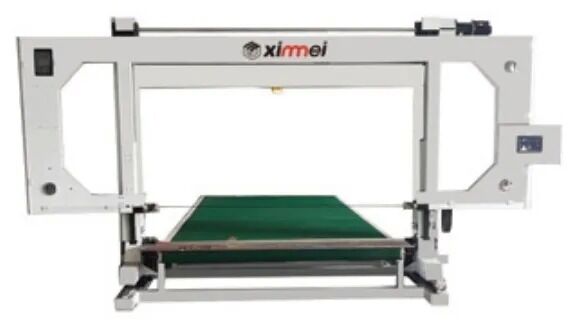
Product Details
Place of Origin: Qingdao
Brand Name: Xinmeiteng
Certification: CE
Model Number: TDPO-2.2
Payment & Shipping Terms
Minimum Order Quantity: 1 Set
Price: Inquiry
Packaging Details: TO BE DETERMINED
Delivery Time: 45 working days after downpayment
Payment Terms: L/C,T/T
Supply Ability: 3 sets per season
Cutting Size: |
6000*2100 Mm |
Cutting Height: |
1300 Mm |
Blade Speed: |
0-70 M/min |
Blade Turning Angle: |
±360° |
Precision Tolerance: |
±0.5 Mm |
Motor Power: |
8.5 KW |
Cutting Size: |
6000*2100 Mm |
Cutting Height: |
1300 Mm |
Blade Speed: |
0-70 M/min |
Blade Turning Angle: |
±360° |
Precision Tolerance: |
±0.5 Mm |
Motor Power: |
8.5 KW |
The TDPO-2.2 works a 6000*2100 mm table, which is long enough for several profiles to be nested on one block. The revolving loop blade turns ±360° in the cut, blade speed runs 0-70 m/min, cutting height is 1300 mm, minimum radius is 10 mm, precision is ±0.5 mm, motor power is 8.5 kW and the machine weighs 3.5 t.
Table size is a productivity decision. On a short table, each profile needs its own block and its own set-up; on a 6000 mm table, a whole nest of parts comes off one block in one run. The saving is not the cutting time, it is the loading and the offcuts.
A full nest of parts comes off one block instead of one part per set-up.
Speed is set per foam grade so soft and firm foam both cut cleanly.
Each profile is followed continuously without a blade lift or re-entry mark.
A nest that is planned well leaves the block rigid until the last part. Cutting parts in the wrong order leaves the block unsupported and the last pieces come out off-size.
The saving on a 6000 mm table is not the cutting speed. It is the number of times a block has to be loaded, squared and set up. Every load is a chance to lose squareness and a fixed cost in labour, and on contoured parts that cost is often larger than the cut itself.
Nesting also reduces offcut. Parts arranged on one block can share the space between profiles; parts cut one at a time each carry their own margin. Over a month of production the difference in foam purchased is measurable.
The constraint is planning. A nest needs a file that the machine can follow without crossing a previous cut, and an operator who checks the first part before releasing the batch. On a long table a wrong setting wastes a whole nest, not one part.
| Parameter | Value |
|---|---|
| Model | TDPO-2.2 |
| Cutting size | 6000*2100 mm |
| Cutting height | 1300 mm |
| Minimum cutting radius | 10 mm |
| Band blade speed | 0-70 m/min |
| Blade turning angle | ±360° |
| Precision tolerance | ±0.5 mm |
| Total motor power | 8.5 kW |
| Machine weight | 3.5 t |
| Certification | CE |
| Symptom | Likely cause | Action |
|---|---|---|
| Profile drifts from the drawing | Blade tension dropped or guide worn | Re-tension the blade, check guide clearance, re-cut a test piece |
| Corner radius comes out oversized | Blade too wide for the radius or speed too high | Fit the micro tooth loop blade and reduce the blade speed |
| Torn edges on soft foam | Blade speed mismatched to the foam grade | Adjust blade speed inside 0-70 m/min for latex and memory foam |
| Profile not square through the height | Block not square on the table | Square the block before loading and check table alignment |
| Program stops mid-cut | Nesting file error or limit switch tripped | Check the file and the limit switch, then re-run from the last point |
| Blade breaks | Overtension or metal debris inside the foam | Check tension and inspect the block before cutting |
Contour faults are usually visible on the first part off the table. Cut one test profile before running the nest, and a wrong radius costs one part instead of a batch.
The table is 6000*2100 mm, so the floor plan needs that footprint clear plus access on the loading side. A table that is blocked at one end forces short nests and gives back most of the productivity the machine offers.
Keep the table surface clean. Foam dust under a block changes the cutting height by a fraction, and on a ±0.5 mm machine that fraction matters at the top of a 1300 mm block.
On a long table, rail and table alignment matter as much as the blade. Check the table surface and the rail weekly, because a slight misalignment over 6000 mm shows up as a profile that is right at one end and off at the other.
Blade tension and guide clearance stay on the daily list. A blade that is starting to slack tracks differently at the far end of the table, which is exactly where it is hardest to see.
The machine ships in export packing with the head blocked and the table protected. At 3.5 t and a 6000*2100 mm table, confirm the container plan and the receiving access before the shipment date.
Delivery is 45 working days after downpayment, payment by T/T or L/C, minimum order one set. Nesting software support, installation guidance and spare loop blades ship with the machine.
A: 6000*2100 mm, long enough to nest several profiles on one block.
A: 0-70 m/min, set per foam grade.
A: ±0.5 mm, checked at both ends of the table.
A: 1300 mm cutting height and a 10 mm minimum radius.
A: 45 working days after downpayment, T/T or L/C, minimum order one set.
Tell us the foam type, block or roll size, target sheet thickness and expected output per shift. We will confirm the machine configuration, quote it and share the delivery schedule. Spare blades, guide parts and remote commissioning support are available with every order.